Discover a Christian meditation on Jesus’ call to lift up your head, overcome fear and embrace God’s hope.
Lift up your heads: the Gospel of hope in the midst of upheaval
Introduction
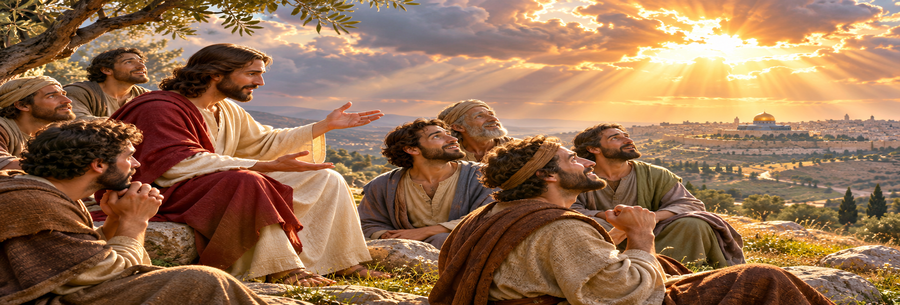
Today’s Gospel uses powerful imagery: Jerusalem under siege, nations in turmoil, the roaring sea, the stars shaken, and people gripped by fear. Yet, amidst this unsettling scene, Jesus speaks words of immense hope: ‘Stand up and lift up your heads, for your redemption is drawing near.’
These words do not deny the crises, sufferings or anxieties afflicting the world and our lives. Above all, it reveals to us that God never abandons us. When everything seems unstable, Christ invites us not to shut ourselves away in fear, but to lift our eyes to him.
The Catholic liturgy thus leads us to reinterpret events through the lens of faith. Instead of seeing only what threatens us, Christians are called to recognise the presence of God, who comes to save, lift up and lead his people towards the light.
A Gospel that speaks of upheavals
Jesus foretells difficult times. His disciples hear words that may bewilder them: conflict, destruction, fear and distress. This passage from the Gospel does not seek to satisfy curiosity about the future. It gives no dates or precise scenarios. It teaches us a spiritual attitude.
Faced with upheavals, Jesus does not ask his disciples to deny reality. He does not tell them that nothing serious will happen. Rather, he teaches them not to let fear take over their hearts.
We, too, may experience times when our sense of security is shaken. A family worry, an illness, a conflict, financial difficulties, a loss of confidence or extreme fatigue can make us feel as though we are surrounded by forces beyond our control.
At such times, Christ’s words become a light. He reminds us that history is not left to chance. God remains present, even when we do not yet understand what is at stake.
‘Stand up straight and lift up your heads’
The act of lifting up one’s head is very concrete. A person who is worried often lowers their gaze, withdraws into themselves and can no longer see beyond their fear. Jesus invites us to step out of this inward-looking stance.
Lifting up one’s head does not mean ignoring difficulties. It means refusing to let them entirely define our future. It means believing that suffering, failure or chaos do not have the final say.
These words are a call to Christian hope. Hope is not a naïve optimism that simply repeats that everything will be fine without effort or struggle. It is the certainty that God is faithful, that his love is stronger than evil, and that the risen Christ walks with us.
When Jesus speaks of redemption, he proclaims liberation. God comes to deliver us from what imprisons us: fear, sin, despair, loneliness and violence. This deliverance begins already in the heart of those who choose to turn to him.
Do not let fear become our guide
In the Gospel, Jesus speaks of people who are paralysed by fear in the face of what is happening in the world. Fear can indeed become an immense burden. It prevents us from making decisions, from trusting, from loving and even from praying.
Some fears are understandable. They can alert us and help us to act with caution. But they become dangerous when they take control of our outlook on life. They can lead us to shut ourselves off from others, to believe the most pessimistic narratives, or to forget the signs of goodness that still exist.
Christian meditation teaches us to entrust our fears to God. We can bring them before him without shame, in simple words: ‘Lord, I am worried. Help me not to be left alone with this worry. Give me your peace.’
Jesus does not promise that everything will be easy. He promises to be present. Faith does not necessarily take away our questions, but it prevents us from bearing them alone.
The Son of Man comes with power and glory
At the heart of this passage, Jesus announces the coming of the Son of Man with power and great glory. This expression reminds us that Christ is Lord of history. He does not stand aloof from our struggles: he comes to meet us.
For Christians, the return of Christ is not a threat intended to frighten. It is the fulfilment of a promise. The One who will come in glory is the One who shared our human condition, who experienced weariness, abandonment, suffering and death. He is the Risen One who still bears the marks of his love.
This certainty transforms the way we live. We are not called to wait passively for a distant future. We are invited to welcome Christ right now: in prayer, in the Word of God, in the sacraments and in the faces of our brothers and sisters.
Every act of peace, justice and mercy is already preparing the Kingdom of God.
A hope to be lived out in daily life
Today’s Gospel invites us to choose hope in the small realities of life. Lifting up our heads can mean taking the time to pray in the midst of a busy day. It can mean asking for forgiveness, regaining courage after a mistake, visiting someone who is lonely, or thanking God for a quiet grace.
Hope is also nourished by gratitude. When we take the time to recognise what is beautiful, good and true around us, our perspective changes. We discover that God often acts in simple ways: through a smile, an unexpected act of kindness, a comforting word, a reconciliation or a light rediscovered after a dark period.
We might also ask ourselves: what is it in my life that causes me to hang my head? What fear is holding me back? To whom can I entrust this worry?
Christ answers us gently: ‘Rise up. I am with you.’
The Catholic liturgy: a school of hope
The Catholic liturgy is a place where the Church learns to hope. At Mass, we hear the Word of God, we pray for the world, we present our intentions and we receive the presence of Christ in the Eucharist.
Even when the world seems in turmoil, the Christian community continues to sing, pray and give thanks. It proclaims that God is faithful and that his love endures.
The liturgy teaches us to look beyond the immediate. It reminds us that our lives have a purpose, that our history is called to an encounter with God, and that Christ continually renews his people.
By taking part in the Church’s prayer, we find a strength that goes beyond our own resources. We discover that hope is a grace to be sought and shared.
Practical meditation: choosing to lift up your head
Take a few moments of silence. Think of a concern that is weighing heavily on your mind. Do not immediately seek a solution. Simply present it to the Lord.
You might repeat slowly: ‘Jesus, I want to lift up my head and place my hope in you. ”
Then choose a practical action for today: call someone who needs support, limit what fuels your anxiety, read a few lines from the Gospel, make peace with someone, or take a moment of silence before God.
Hope grows when it becomes a daily choice. It does not make difficulties disappear, but it enables us to get through them without losing confidence.
Prayer to rediscover hope
Lord Jesus,
when my heart is troubled
and my worries take over,
teach me to lift my eyes to you.
Grant me peace in times of trial,
confidence amidst uncertainty
and the strength to recognise your presence in my life.
May your love nurture a steadfast hope within me.
Amen.
FAQ on the Gospel of Hope
Why does Jesus speak of troubling signs?
Jesus refers to the upheavals of history to teach his disciples not to let themselves be ruled by fear. His main message is a call to keep our trust in God.
What does ‘lifting up our heads’ mean in the Christian faith?
It means rising above discouragement, refusing to be trapped by anxiety, and turning our gaze towards Christ, the source of peace and salvation.
Is Christian hope different from optimism?
Yes. Optimism often depends on circumstances, whilst Christian hope is based on God’s faithfulness, even when situations seem difficult.
How can one pray when one is worried about the future?
One can pray using very simple words: entrusting a specific fear to God, asking for peace, and slowly repeating the name of Jesus. Prayer does not require us to understand everything, but to place ourselves in God’s hands.
How can we live out this Gospel in our daily lives?
By performing small acts of hope: praying, giving thanks, helping someone in difficulty, forgiving, regaining courage after a setback, and choosing to believe that God is still at work in our lives.
Liturgical reference: The Gospel according to Saint Luke, chapter 21, verses 20 to 28.