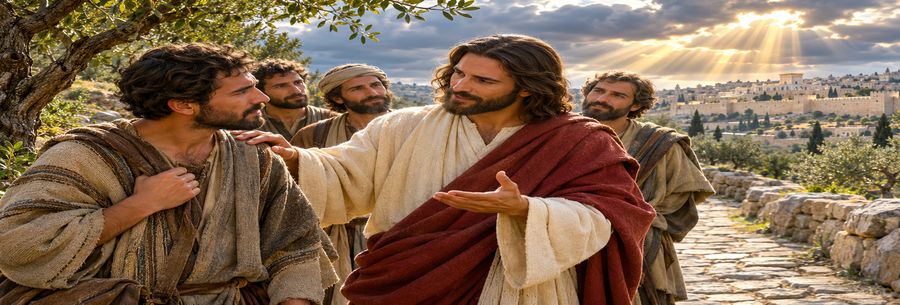
Reflect on the Gospel passage in which Jesus calls his disciples to perseverance: a message of hope, trust and faithfulness in the face of trials.
Persevering in faith: Jesus’ promise at the heart of trials
Introduction
Today’s Gospel may come as a surprise due to its seriousness. Jesus speaks to his disciples about the opposition, misunderstanding and persecution they may face because of their faith. Yet his message is not one of fear. At the heart of these demanding words lies a powerful promise: Christ will be with his own and will give them the strength to stand firm.
This passage from the Catholic liturgy resonates deeply with our lives. Without necessarily experiencing persecution, many Christians experience loneliness in their faith, the judgemental gaze of others, discouragement, family wounds or the difficulty of remaining faithful to the Gospel in a world that is sometimes indifferent.
Jesus does not promise us the absence of trials. He promises us his presence, his wisdom and the grace to persevere. He teaches us that humble faithfulness, lived out day by day, becomes a true witness.
The Gospel: a saying of Jesus on faithfulness
Jesus tells his disciples that they may be handed over, accused, rejected and even betrayed by those close to them. These are powerful words. They reveal that following Christ is not always comfortable. The Christian faith engages one’s whole life and can sometimes bring one into conflict with the ways of the world, personal interests or the choices of those around us.
But Jesus immediately adds that these trials will become an opportunity to bear witness. Where the disciples might see only an obstacle, Christ opens a path for them. Their faithfulness, their peace and their trust will speak of God more powerfully than long speeches.
The Lord also asks them not to worry in advance about how they will have to defend themselves. He promises to give them the necessary words and wisdom. This teaching does not invite us to be reckless or to remain silent, but to entrust our words to God. When we sincerely seek to live according to the Gospel, the Holy Spirit can inspire us with the right words, the appropriate actions and the strength not to respond to violence with violence.
‘ ‘This will lead you to bear witness’
Christian witness does not always consist of doing great things. It often begins in very ordinary situations: refusing to lie, choosing forgiveness, standing up for someone who is looked down upon, remaining honest when it seems to come at a cost, preserving peace within a family, or not giving in to despair.
To bear witness is to let something of Christ’s love shine through in the way we live. It is not about convincing others at any cost, nor about imposing one’s faith. It is about living with consistency, gentleness and truth.
Sometimes, the most beautiful witness is that of a person who continues to love despite having been hurt, who prays instead of responding with anger, who holds on to hope in the midst of a trial, or who remains attentive to the most vulnerable. This unassuming witness can touch lives without us even realising it.
The Christian reflection on this Gospel invites us to look at our difficulties in a different light. Certain situations we would like to flee from can become places where our faith grows. Not because suffering is good in itself, but because God can bring light where we initially see only darkness.
Jesus grants wisdom when it is needed
Much of our anxiety stems from the desire to foresee everything. We imagine the difficulties to come, we seek the perfect answers and we fear that we will not know how to cope. Jesus invites us to lay aside this worry.
He does not say that we will always have all the answers. He assures us that when we need it, he will be there. His grace is not given to us in advance to fuel our worries; it is offered to us in the present, where we are called to take a step of faith.
This promise can transform our prayer. Instead of asking God to remove all difficulties, we can ask him for a faithful heart, a word of truth and a deep peace. We can say to him: ‘Lord, give me today what I need to love, to serve and to stand firm. ”
God’s wisdom is not always spectacular. It is often recognised in a measured word, a respectful silence, a courageous decision, a renewed patience or a new ability to listen.
“ ‘Not a single hair on your head will be lost’
This statement may seem surprising, given that Jesus has just spoken of suffering and even death for some of his disciples. It does not mean that believers will be protected from all physical trials. It promises a deeper protection: no human power can tear away from God those who remain attached to him.
Christ reminds us that our lives are precious in his eyes. We are known, loved and watched over by God. Even when we are going through times of vulnerability, our existence does not escape his notice. He is present in our tears, our struggles and our hopes.
These words are a source of comfort for all those who feel vulnerable. They teach us that our ultimate security does not depend on our strength, our reputation or our possessions. It rests on God’s faithfulness.
The Christian faith does not always provide immediate explanations for life’s tragedies, but it offers one certainty: the love of Christ is stronger than any separation, any fear and any death.
Perseverance: a daily journey
Jesus concludes by affirming that it is through perseverance that we will preserve our lives. Perseverance is neither harshness nor prideful obstinacy. It is the grace to remain faithful to God, even when enthusiasm wanes or circumstances become difficult.
To persevere is to continue praying when prayer seems feeble. It is to choose to do good when no one notices. It is returning to God after a fall. It is not letting a disappointment, a trial or a wound have the last word.
In the spiritual life, small, repeated gestures have great power. A short prayer in the morning, a passage from the Gospel meditated upon, a candle lit for an intention, a Mass attended with full attention, an act of charity or forgiveness granted are all building blocks that form a solid faith.
Christian perseverance is never a solitary endeavour. It is sustained by prayer, the sacraments, the Word of God and fellowship with fellow believers. When we can no longer move forward on our own, the Church sustains our faith and prays with us.
A practical reflection for daily life
Take a few moments to reflect on a situation that requires perseverance on your part. It might be a difficult relationship, a worry, inner weariness, a project that is taking a long time to come to fruition, or a habit you are trying to change.
Simply present this situation to the Lord. Don’t try to resolve everything straight away. Ask him for a specific grace to help you move forward: patience, courage, forgiveness, peace or trust.
You could also take a practical step. Perhaps call someone with whom communication is strained, resume a prayer you’ve neglected, refrain from speaking harshly, thank God for a small ray of hope, or take the time to listen to someone. Perseverance often begins with a small, faithful step.
Living the Catholic liturgy with a faithful heart
The Catholic liturgy teaches us perseverance. Week after week, the Church gathers us round the Word and the Eucharist. She reminds us that the Risen Christ is always present, even when our hearts are weary.
At Mass, we come with what we are truly experiencing: our joys, our questions, our sorrows and our intentions. We do not have to be perfect to turn to God. All we need is a willing heart.
The liturgical celebration is a place where the Lord renews our strength. It helps us not to live our faith alone and to continue on our journey with the hope that God never ceases to walk with us.
Prayer for perseverance in the faith
Lord Jesus,
when I feel fragile or discouraged,
remind me that you walk with me.
Grant me your wisdom in my words,
your peace in my worries
and the strength to remain faithful to your love.
Teach me to persevere humbly,
day after day, with confidence.
Amen.
FAQ on the Gospel of Perseverance
What does Jesus mean when he speaks of perseverance?
Perseverance is faithfulness to God over time. It involves continuing to believe, to love, to pray and to do good, even when circumstances are difficult.
Why does Jesus tell his disciples that they will face trials?
Jesus prepares his disciples so that they will not be taken by surprise by opposition or a lack of understanding. He also shows them that difficulties can become an opportunity to bear witness to their faith with peace and courage.
How can we receive the wisdom promised by Jesus?
This wisdom is sought through prayer. It also grows through reading the Gospel, listening to the Word of God, the sacraments and the advice of trusted Christians.
Does faith protect us from all suffering?
Faith does not remove all trials, but it gives us the certainty that God remains present. Christ accompanies each of us in our suffering and promises that his love is stronger than anything that seems to afflict us.
How can we persevere when prayer seems difficult?
It is helpful to keep up a simple and regular prayer, even if it is very short. Saying ‘Lord, stay with me’ or entrusting a specific intention to Him can already become a true prayer and maintain our connection with God.
Liturgical reference: The Gospel according to Saint Luke, chapter 21, verses 12 to 19.