On 13 November, let us learn about Saint Brice of Tours, the successor to Saint Martin. His journey of conversion, his trials and his humble perseverance continue to shed light on the Christian life.
Saint Brice of Tours: from fickleness to faithfulness
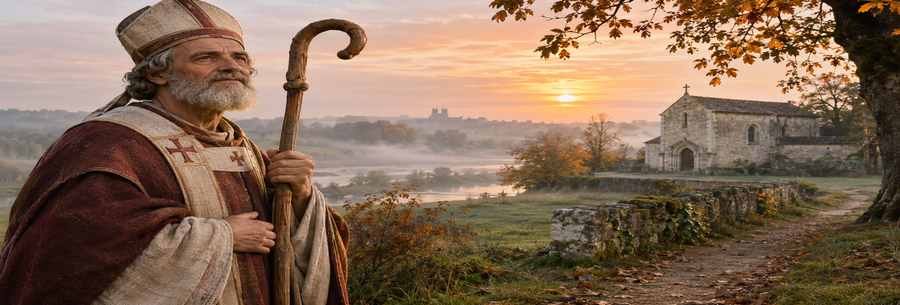
On 13 November, the Roman liturgical calendar marks an ordinary day in the thirty-second week of Ordinary Time. The French calendar of saints, however, honours Saint Brice, Bishop of Tours in the 5th century, known as the successor to Saint Martin.
His story is profoundly human. It does not present a saint who was blameless from childhood, but a man weighed down by his weaknesses, called to allow himself to be gradually transformed by God’s grace. Saint Brice reminds us all that holiness is not reserved for those who appear perfect: it is received and built up through truth, repentance, patience and renewed faithfulness.
A young man taken in by Saint Martin
According to tradition, Brice was taken in at a very young age by Saint Martin of Tours. He therefore grew up in the company of a great bishop, missionary and servant of the poor, whose spiritual influence left a deep mark on Christian Gaul.
Yet being close to a saint does not spare one from inner struggle. Brice does not seem to have immediately received his master’s spiritual legacy. Ancient accounts describe him as a difficult young man, at times proud and drawn to a more comfortable life than that of monks and servants of the Church.
Saint Martin did not reject him. He patiently guided him, neither denying his faults nor losing hope in him. This attitude is in itself a precious lesson: God sees in each person more than their present mistakes. Where we are sometimes quick to pigeonhole a person based on their character, their past or their missteps, the Lord continues to open a path.
Saint Martin’s patience with Brice points to a great Christian truth: no one is permanently defined by their missteps. Grace can touch a heart that has long been closed, and bring a vocation to fruition where no one expected it any more.
Saint Martin’s unexpected successor
When Saint Martin died in 397, Brice succeeded him as Bishop of Tours. This succession might have seemed surprising. How could a man whose youth had been so turbulent take the place of a bishop as admired as Martin?
Brice had a very heavy burden to bear. He was not merely succeeding a predecessor: he was taking over from a figure already regarded as a saint by the Christian people. The memory of Martin was immense. His charity, his missionary courage, his care for the poor and his spiritual influence made him a standard that was difficult to match.
But the Church does not need exact copies. It welcomes different shepherds, each with their own strengths, character and unique path. Saint Brice was not Saint Martin; he was not meant to imitate him outwardly, but to seek to serve the same Lord.
His episcopate was a long one. He is said to have guided the Church of Tours for several decades, during a period marked by the upheavals of the late Roman Empire, political uncertainties and the need to strengthen the Christian faith in both towns and the countryside.
Slander and the ordeal of exile
Tradition recounts that Saint Brice was the victim of serious accusations. A woman is said to have accused him of being the father of her child. Faced with this slander, the bishop had to endure humiliation, misunderstanding and rejection from those he served.
Hagiographic accounts speak of miraculous signs through which his innocence is said to have been demonstrated. Beyond these traditions, Brice’s ordeal remains highly significant: he experienced the suffering of being unjustly judged and of losing the trust of some of his people.
He was removed from his episcopal see and had to go into exile. For a pastor, being separated from his Church is a deep wound. Yet this difficult period was not in vain. It became a time of purification, of inner maturity and of surrender to God.
It is sometimes easier to remain faithful when all is well, when our words are heeded and our work is recognised. Trial reveals what truly dwells in the heart. Saint Brice teaches us that it is possible to continue to love, to pray and to hope, even when our reputation is tarnished or our plans seem to be falling apart.
The return to Tours and humble faithfulness
After several years, Brice was finally recalled to Tours. Those who had doubted him acknowledged his innocence and asked him to resume his position as bishop. This return was not merely that of a man vindicated; it also signified reconciliation.
The saint returned to his people having experienced humiliation and time spent away from his diocese. He was no longer merely the man of difficult temperament described in the earliest accounts. His trials had deepened his humility, compassion and perseverance.
Saint Brice is said to have continued his ministry until his death in the mid-fifth century. He was honoured as a saint by the Christians of Tours, who recognised in his life not the absence of frailty, but the patient work of God.
His holiness resonates particularly deeply with us because it is not based on a flawless life. It is the holiness of a man who experienced contradictions, faults, suspicions, loneliness and a return to peace. It is a holiness of conversion.
What Saint Brice can teach us today
The life of Saint Brice invites us, first and foremost, not to despair of ourselves. Some people have long borne the burden of a mistake, an unfortunate decision or a period in their lives that they regret. Saint Brice reminds us that the past does not have the final say when we entrust it to God’s mercy.
He also invites us not to lose hope in others. In our families, our communities, our workplaces or our parishes, we may sometimes be disappointed by someone’s behaviour. Saint Martin’s patience towards Brice calls us to look upon every person with hope, without condoning evil, but without too quickly withdrawing our trust in the possibility of change.
His story also teaches us to be cautious in our judgements. An accusation, hearsay or appearances can cause lasting harm. Before passing judgement, we must seek the truth, uphold justice and leave room for charity. The Gospel teaches us that truth is never to be confused with rumour.
Finally, Saint Brice shows us that faithfulness can be reborn after a trial. Sometimes we feel as though we have wasted time, that we no longer belong, or that we cannot start afresh. Yet God knows how to open up new paths. He does not erase our history, but he can transform it.
A prayer to Saint Brice
Saint Brice,
you experienced the missteps of youth,
the weight of accusations and the loneliness of trial.
Teach us never to despair
of God’s mercy.
Grant us a humble heart in times of success,
patience in the face of injustice
and faithfulness when the path becomes difficult.
Help us to look upon others with hope,
to seek the truth with charity
and to return to the Lord with all our hearts.
Amen.