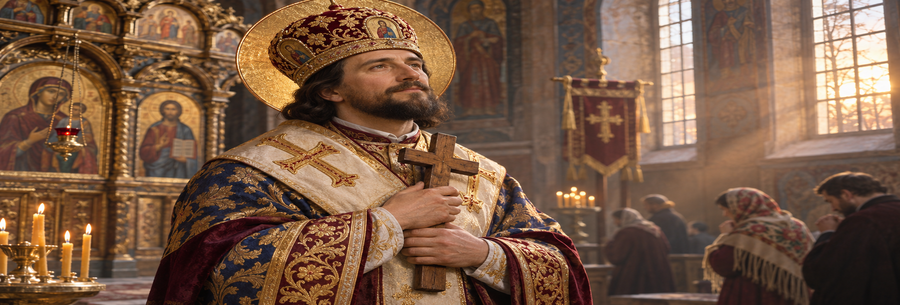
Discover Saint Josaphat, a 17th-century bishop and martyr, who gave his life for the unity of the Church whilst respecting Eastern traditions.
Saint Josaphat, a courageous witness to Christian unity
On 12 November, the Church commemorates Saint Josaphat, bishop and martyr. His life was deeply linked to the desire for unity between Eastern and Western Christians. In an era marked by intense religious, political and cultural tensions, he sought to serve Christ by working towards reconciliation, without denying the richness of the Byzantine tradition to which he belonged.
Saint Josaphat is not a saint of uniformity. On the contrary, he reminds us that Christian unity does not consist in erasing languages, cultures or rites. It consists in recognising that all the baptised belong to the same Christ and are called to move forward together in faith, charity and peace.
His witness still speaks today to all those who suffer from divisions, misunderstandings or conflicts. He invites us to become builders of unity, first and foremost within our families, our parishes and our daily relationships.
A youth marked by the search for God
Saint Josaphat was born around 1580 in Volhynia, a region now situated between Ukraine and Belarus. At birth, he was given the name John. His country was then deeply divided between Catholic and Orthodox Christians.
From a very young age, he was drawn to the spiritual life. He initially worked for a merchant, but gradually felt a deeper calling. He realised that material possessions and a comfortable life were not enough to fulfil the human heart. His desire was to give himself entirely to God.
He entered the Monastery of the Holy Trinity in Vilnius and took the name Josaphat. He became a Basilian monk, following the spiritual tradition of Saint Basil. This monastic life placed great demands on him in terms of prayer, simplicity and service.
Josaphat had a deep love for the Eastern liturgy, Byzantine chants, the prayer of the Church and the traditions of his people. He never considered that unity with Rome should cause this richness to disappear. On the contrary, he saw in the diversity of Christian traditions a beauty that could lead to the praise of God with one voice.
A pastor in the service of unity
At the end of the 16th century, part of the Ruthenian Church chose to restore communion with Rome whilst retaining its Eastern liturgy and its own customs. This decision, often referred to as the Union of Brest, gave rise to great hope, but also to fierce opposition.
Josaphat then devoted himself fervently to the cause of unity. He became a priest and then Bishop of Polotsk. His mission was a difficult one, as the tensions extended far beyond purely religious matters. They also touched on history, the identity of peoples, politics and local rivalries.
As bishop, Saint Josaphat sought to reform Christian life, to train priests, to visit communities and to encourage prayer. He wanted the faithful to be able to live out their faith with sincerity and depth.
He championed communion with the Catholic Church, but he also wished to preserve the dignity and traditions of the Christian East. His vision of unity was not one group dominating another. It was a communion in which everyone retained what was beautiful and true about their own tradition, whilst recognising the same faith in Christ.
Unity is not built through violence
The life of Saint Josaphat reminds us of an essential truth: religious divisions cause suffering. When mixed with fear, prejudice and political interests, they can deeply wound peoples and families.
Josaphat faced fierce opposition. He was subjected to insults, accusations and threats. Yet he continued to speak out courageously, without responding to hatred with hatred.
According to tradition, he is said to have told those who rejected him that he carried them in his heart and that he would be prepared to give his life for them. These words are deeply moving. They show that his desire for unity did not stem from personal ambition, but from a sincere love for his people and for the Church.
In 1623, during a pastoral visit to Vitebsk, Saint Josaphat was murdered by a hostile mob. He died a martyr, faithful to his mission and to his desire for communion amongst Christians.
His death was not a victory for violence. It became a call to peace. It reminds us that one can never proclaim Christ through coercion or contempt. Faith is offered in freedom, truth and love.
Saint Josaphat and the richness of the Eastern Churches
The memory of Saint Josaphat is particularly important for the Eastern Catholic Churches. It reminds us that the Catholic Church does not have just one way of praying, celebrating or expressing the faith.
The Eastern traditions have preserved an immense spiritual wealth: the beauty of icons, chanted liturgies, the Liturgy of the Hours, fasting, contemplation and a deep focus on the mystery of God.
Saint Josaphat helps us to understand that Christian unity does not require us all to become alike. God loves the diversity of peoples. He calls upon every culture to offer its finest qualities in the service of the Gospel.
In an age when differences can sometimes become a source of mistrust, his example encourages us to regard one another with respect. We can learn from one another, discover how faith is lived out in other traditions, and rejoice in whatever leads us closer to Christ.
Building unity in our daily lives
We may not face the great divisions of the Church’s history, but we are all familiar with conflicts, misunderstandings and divisive words.
Saint Josaphat invites us to begin building unity right where we are. This might mean:
- choosing not to dwell on hurtful words;
- listening to someone with whom we disagree;
- asking for forgiveness after an argument;
- praying for someone who has caused us pain;
- embracing differences without compromising our convictions;
- seeking what unites us rather than what divides us.
Unity does not mean that all conflict disappears immediately. It begins when we refuse to let anger and pride rule our hearts. It grows when we choose to believe that, with God’s grace, reconciliation remains possible.
Prayer to Saint Josaphat
Saint Josaphat,
you gave your life
for Christian unity
and for peace amongst peoples.
Teach us to love the Church
in the diversity of her traditions
and to seek what unites us
rather than what divides us.
Grant us a humble heart,
capable of listening, of forgiving
and of reaching out
when reconciliation seems difficult.
Intercede for all Christians,
that they may bear witness together
to the love of Christ
through peace, truth and charity.
Amen.