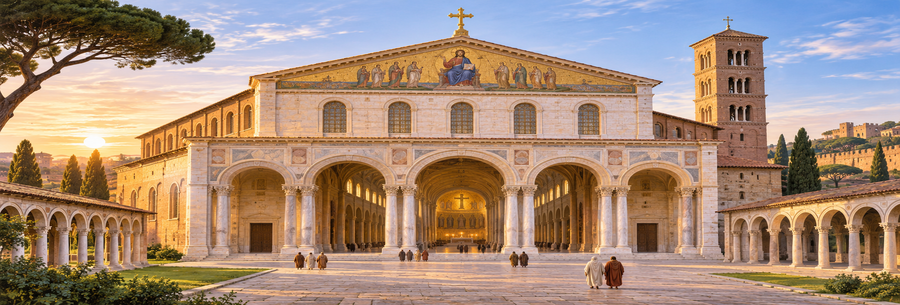
On 9 November, the Church celebrates the dedication of the Basilica of St John Lateran, the cathedral of Rome and a symbol of unity amongst all the baptised.
Dedication of the Lateran Basilica: the Church built of living stones
On 9 November, the Catholic Church celebrates the dedication of the Lateran Basilica. This celebration is a feast day in the universal liturgical calendar.
It is not simply a matter of commemorating an ancient monument or one of Rome’s great Christian sites. Through the Basilica of St John Lateran, the Church invites us to contemplate the mystery of communion: the Church is a people gathered together by Christ, a house open to all and a spiritual temple made up of believers called to become ‘living stones’.
Why do we celebrate the Basilica of St John Lateran?
The Basilica of St John Lateran is the cathedral of Rome, that is to say, the church where the see of the Bishop of Rome – the Pope – is located. It is therefore, symbolically, the principal church of the Diocese of Rome and a sign of the unity of the Catholic Church centred on the successor of Saint Peter.
Its full title is the Archbasilica of the Most Holy Saviour, and of Saints John the Baptist and John the Evangelist. It is commonly known as ‘St John Lateran’ after the neighbourhood and the ancient Roman family of the Laterani.
Its dedication dates back to the 4th century, after Christians had been granted the freedom to practise their faith. The basilica was consecrated in 324 under Pope Sylvester I, on land donated by Emperor Constantine.
The celebration on 9 November gradually spread to the whole Latin Church. It serves as a reminder that every Christian community, even those far from Rome, remains united to the universal Church through the same faith, the same sacraments and fraternal communion.
‘Mother and head of all churches’
The Lateran Basilica bears a famous inscription: it is called ‘mother and head of all the churches of the city and of the world’. This expression does not mean that other churches are any less important or any less loved by God. It emphasises the special place of Rome’s cathedral within the communion of the Catholic Church.
This feast helps us to understand that the Church is not merely a collection of isolated groups. Christians from every country, every language and every culture form a single people, called to live in unity despite their differences.
Christian unity does not mean that everyone must think, pray or act in exactly the same way. It consists in recognising Christ as the foundation, receiving his Gospel and choosing charity. In a world where divisions are rife, this feast reminds us that unity is a gift to be welcomed and a mission to be built upon every day.
Christ is the true temple
The readings for this feast take us beyond the stones of a building. In the Gospel, Jesus drives the merchants out of the Temple in Jerusalem. He reminds us that the house of God is not just any place: it is a space for encounter, prayer and truth.
But Jesus also reveals a deeper mystery: his own body is the true Temple. In him, God comes to dwell amongst humankind. Through his death and resurrection, Christ opens the way for everyone to a living relationship with the Father.
Thus, a church is important not only for its beauty, its history or its heritage. It is precious because it brings the faithful together for prayer, the celebration of the Eucharist, forgiveness, baptism, marriage, funerals and all the major moments of Christian life.
To enter a church is to remember that we are not alone. It is to find a place where we can lay down our sorrows, give thanks for our joys and entrust those we love to the Lord.
We are the living stones of the Church
The Lateran Basilica is a grand building, but the true Church is made up of the baptised. Each of us is called to become a living stone in the house of God. On this feast day, Pope Leo XIV reminded us that the basilica is a sign of the living Church, built upon Jesus Christ, the cornerstone.
This is a beautiful image. A single stone does not build a house. It finds its place alongside other stones, bound together by a solid foundation. In the same way, we need one another to live out our faith.
To be a living stone is to contribute to the building up of the Church through concrete actions:
- welcoming those who are new or who feel alone;
- praying for those who are suffering;
- sharing the faith gently;
- serving in one’s parish as best one can;
- offering encouragement rather than discouragement;
- seeking reconciliation when a relationship has been damaged;
- caring for the most vulnerable.
Holiness does not necessarily mean doing extraordinary things. It is often manifested in day-to-day faithfulness: a presence, a listening ear, forgiveness, a word of peace or a quiet act of service.
A house of prayer open to the world
Churches are not places closed in on themselves. They are called to be open houses, where everyone can come to seek God. Anyone who enters a church with their questions, their grief or their gratitude must be able to find there a space of silence, beauty and hope.
This feast is also an invitation to respect our places of worship. Looking after a church, decorating it with flowers, maintaining it, and praying there with reverence is to honour the God who gathers his people together. But we must never forget that the most beautiful sanctuary to protect is the human heart.
God desires to dwell within us. He calls us to become places of peace for our loved ones, of comfort for those who suffer, and of light for those seeking a path.
Prayer for the unity of the Church
Lord Jesus,
you are the cornerstone
upon which your Church is built.
Make us living stones,
united by faith, hope and love.
Teach us to welcome our brothers and sisters
in all their differences and frailties.
Keep your Church in unity,
support the Pope, the bishops, the priests
and all the baptised who are called to proclaim your Gospel.
Make our homes, our parishes
and our hearts
places of prayer, peace and mercy.
Amen.