The Feast of the Blessed Sacrament, also known as "Corpus Christi", is one of the great solemnities of the Catholic Church. It honours the central mystery of the Christian faith: the real presence of Jesus Christ in the Eucharist, under the species of bread and wine. Instituted in the 13th century, this feast is celebrated on the Thursday following the solemnity of the Holy Trinity, or on the following Sunday in many countries. It invites us to contemplate the miracle renewed every day at Mass: God makes himself present, humbly, in a piece of consecrated bread.
Origins and spiritual significance
The origin of this feast goes back to a profound mystical experience. Around 1209, Saint Julienne du Mont-Cornillon, a Belgian Augustinian nun, received visions of Christ asking her for a specific feast in honour of his Body and Blood. She saw the Church as a luminous disc, marked by a dark spot: the absence of a feast dedicated to the Eucharist. Supported by the local clergy and in particular by the future Pope Urban IV, this feast was first celebrated in Liège, then extended to the whole Church in 1264 by the bull Transiturus de hoc mundo.
The Feast of the Blessed Sacrament aims to publicly honour what lies at the heart of the Christian faith: Jesus living in the Eucharist. Each Mass renews Christ's sacrifice on the cross, and each communion is an act of intimate union with Him. But this feast also provides an opportunity to step outside the walls of the church to proclaim to the world, through the procession, that God is there, that He walks among His people.
Eucharistic processions
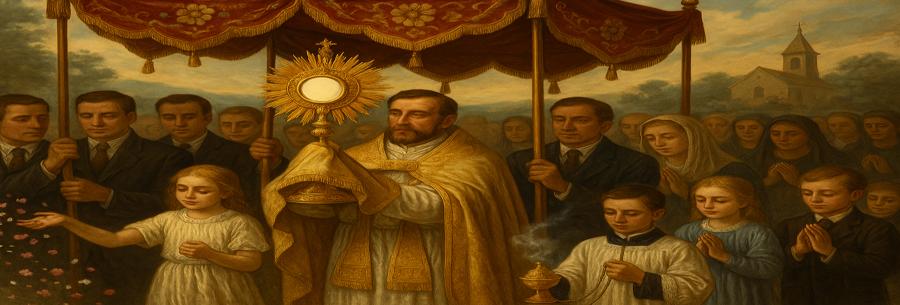
Traditionally, Corpus Christi is marked by a solemn procession in which the priest carries the Blessed Sacrament in a monstrance, under a canopy, through the streets. This procession is an act of faith, but also of public witness. The faithful, often dressed in festive costumes, sing, pray, decorate the paths with flower petals and set up altars of rest. It's a moment of great popular fervour, a joyful act of communal adoration.
In some regions, the procession takes on spectacular dimensions. In Rome, it is sometimes led by the Pope himself. In the countryside, local traditions embellish the rite with ancient customs: altar boys throwing flowers, colourful banners, bells ringing out. These gestures, whether simple or grandiose, all say the same thing: Jesus is in our midst.
A feast to deepen Eucharistic love
Beyond its outward manifestations, the Feast of the Blessed Sacrament is an invitation to an inner conversion: that of a heart that recognises God in the silence of the host. It encourages believers to renew their love of the Eucharist, to adore more and to receive communion with greater fervour. It also calls us to live according to the Eucharist: in self-giving, humility, and charity.
For if Jesus becomes food, it is so that we in turn become shared bread. Every time we attend Mass, take Communion or pray before the tabernacle, we are called to let God transform us. Eucharistic adoration, which continues this feast throughout the year, then becomes a place of light and peace, where the heart refocuses on what is essential.
A mystery to be lived every day
The Feast of the Blessed Sacrament reminds us that the mystery of the Eucharist is not reserved for great celebrations. It is lived every day, in the ordinary of the Mass, in the discreet chapels, in the heart of each and every one of us. Christ awaits us, silent and alive, ready to nourish our faith and our hope.
As we celebrate this feast, we give thanks for this priceless gift. We proclaim that Almighty God humbly made himself bread to walk with us. We confess our faith in his real presence, and we offer him our love in return.