As the days grow shorter and the first Christmas lights begin to illuminate our towns and homes, a particularly precious time is approaching in the lives of Christians: the season of Advent.
Much more than simply a time of anticipation leading up to the festive season, Advent is a spiritual journey that leads us towards one of the greatest mysteries of the Christian faith: the birth of Jesus Christ, the Son of God, who came to share in our human condition to reveal to us the Father’s love.
For four weeks, the Church invites us to slow down, to rediscover inner silence, to deepen our prayer and to open our hearts to the coming of the Saviour.
In a world where material preparations sometimes take centre stage, Advent reminds us that Christmas is not merely about decorations, presents or family gatherings. At the heart of this celebration lies a child born in the simplicity of a stable in Bethlehem, more than two thousand years ago.
That child is Jesus, Emmanuel, ‘God with us’.
In 2026, the season of Advent will begin on Sunday 29 November and will last until Christmas Eve, 24 December.
Four weeks to embrace hope, rediscover peace, deepen our faith and prepare our hearts for the coming of Christ.
What is Advent and what is its Christian significance?
The word ‘Advent’ comes from the Latin adventus, which means ‘coming’ or ‘arrival’.
In the Christian tradition, this term refers to the period of preparation for the celebration of the birth of Jesus Christ.
But Advent has an even deeper meaning.
It invites us to contemplate three essential dimensions of the Lord’s coming.
The first is the coming of Jesus into history, when he was born in Bethlehem of the Virgin Mary. This extraordinary event marks God’s entry into our humanity. The Creator chose to become a small child, humble and vulnerable, in order to draw closer to each one of us.
The second is the coming of Christ into our daily lives. Jesus continues to come to meet us through prayer, the Word of God, the sacraments and the acts of love we perform towards our neighbour.
The third is the anticipation of Christ’s glorious return, at the end of time, when his Kingdom will be fully revealed.
Advent thus places us between the memory of Jesus’ birth, his living presence today and the hope of his return.
This waiting is not passive. It invites us to transform the way we live, to draw closer to God and to prepare our hearts to receive his light.
In the Gospel according to Saint Matthew, Jesus calls us to be watchful:
‘Therefore, keep watch, for you do not know on what day your Lord is coming.’ (Matthew 24:42)
These words sum up the spirit of Advent: to remain awake in faith, attentive to God’s presence and ready to welcome his love.
When does Advent begin in 2026?
In 2026, the first Sunday of Advent will be celebrated on 29 November.
This Sunday also marks the beginning of a new liturgical year for the Catholic Church.
Unlike the calendar year, which begins on 1 January, the liturgical year begins with the anticipation of the Saviour’s birth.
Advent comprises four Sundays, each inviting us to deepen a different aspect of our spiritual preparation.
First Sunday of Advent: 29 November 2026, entering into hope
The first Sunday calls us to vigilance and hope.
It reminds us that God keeps his promises and that his light can illuminate even the most difficult situations.
This is the time to begin our journey towards Christmas by asking ourselves what place we truly give to the Lord in our lives.
Do we still have time to pray? Do we recognise those who need our presence? Are we ready to welcome Jesus with simplicity?
This first Sunday is an invitation to open our hearts.
Second Sunday of Advent: 6 December 2026, preparing the way of the Lord
The second Sunday places particular emphasis on the figure of Saint John the Baptist.
His mission is to announce the coming of the Messiah and to call people to repentance.
His call still resounds today:
‘Prepare the way of the Lord; make his paths straight.’ (Matthew 3:3)
Preparing the way of the Lord means making room in our lives for what truly matters.
This may involve reconciliation, granting forgiveness, giving up a bad habit, or a decision to devote more time to God.
Advent invites us to a conversion of the heart, lived out in trust rather than fear.
Third Sunday of Advent: 13 December 2026, welcoming joy
The third Sunday of Advent is called Gaudete Sunday, from the Latin gaudete, which means ‘Rejoice’.
The liturgy invites us to enter into joy, as the celebration of the Saviour’s birth draws near.
This Christian joy does not depend solely on external circumstances.
It springs from the certainty that God loves us, that he remains faithful and that he does not abandon us.
Even when we are going through trials, Christian hope reminds us that the light of Christ can reach our lives.
On this Sunday, the colour pink may replace purple in the liturgical vestments, as a sign of joy amidst the waiting.
Fourth Sunday of Advent: 20 December 2026, welcoming Jesus with Mary
The fourth Sunday brings us closest to the mystery of Christmas.
The Virgin Mary plays an essential role in this final stage.
Through her ‘yes’ to the angel Gabriel, she freely accepts to become the mother of the Saviour.
Her attitude is a model of faith, humility and trust.
Mary does not know in advance all the difficulties she will face, but she chooses to surrender herself to God’s will.
Following her example, we are invited to welcome Christ without seeking to control everything, leaving more room for trust and love.
The Advent wreath: a symbol of light and hope
One of the most cherished Christian traditions of this season is the Advent wreath.
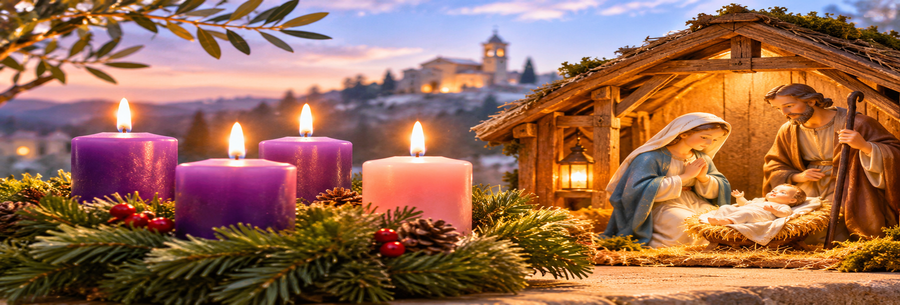
Usually made of fir branches or other evergreen plants, it is adorned with four candles corresponding to the four Sundays leading up to Christmas.
Its circular shape evokes the eternity of God and his love, which has no beginning and no end.
The evergreen branches symbolise life and hope, even in the depths of winter.
As for the candles, they represent the light that gradually grows brighter as we approach Christmas.
Each Sunday, a new candle is lit.
In the first week, a single flame lights up the wreath. In the second week, two candles shine. Then three, and finally four.
This simple gesture reminds us that Christ is the light of the world, who came to illuminate the darkness.
In some traditions, three candles are purple and one is pink, the latter being lit on the third Sunday of Advent.
In other families, the candles are all white or red. The colours may vary, without altering the essential meaning of this tradition.
Lighting the Advent wreath as a family can be a lovely moment of reflection.
It takes just a few minutes to read a passage from the Gospel, offer up a prayer intention and give thanks to the Lord for the blessings received.
Thus, week after week, the growing light of the candles accompanies our spiritual journey towards Bethlehem.
Why is the colour purple associated with Advent?
In the Catholic liturgy, purple is traditionally used during the season of Advent.
This colour expresses inner preparation, vigilance and conversion.
It reminds us that the anticipation of Christmas should not be merely external, but must also engage our hearts.
However, Advent should not be confused with Lent.
Although both periods invite us to prayer and conversion, they have different spiritual emphases.
Lent prepares Christians for the Passion and Resurrection of Christ, whilst Advent is deeply marked by hope and the joyful anticipation of his coming.
The colour purple of Advent is therefore not an invitation to sadness.
Rather, it encourages us to rediscover a certain simplicity so that we may better welcome the joy of Christmas.
The Virgin Mary, our guide during the season of Advent
It is impossible to live Advent to the full without contemplating the Virgin Mary’s place in the mystery of the Incarnation.
When the angel Gabriel announced to her that she would become the mother of the Son of God, Mary replied with admirable trust:
‘Behold, I am the handmaid of the Lord; let it be done to me according to your word. ” (Luke 1:38)
This response marks a decisive moment in the history of salvation.
Mary agrees to welcome Jesus into her life, despite the uncertainties and difficulties that this mission may entail.
During Advent, she teaches us to wait in faith.
Her waiting is not characterised by impatience or restlessness, but by love, silence and inner openness.
She carries within her the One who comes to save the world.
As we reflect on her example, we discover that preparing for Christmas means, above all, learning to say ‘yes’ to God.
The Feast of the Immaculate Conception, celebrated on 8 December, is also a particularly important moment during this season.
It invites us to contemplate the grace granted to Mary and her unique place in God’s plan.
We can use this day to entrust our families, our children, our worries and our hopes to her.
Saint Joseph, an example of trust and faithfulness
Alongside Mary, Saint Joseph plays a vital role in the preparations for Christmas.
A just, humble and deeply devout man, Joseph too accepted a mission that was beyond his understanding.
When he learnt that Mary was expecting a child, he went through a period of doubt.
But the angel of the Lord reveals to him in a dream the divine origin of this birth and urges him not to be afraid to take Mary into his home.
Joseph responds with obedience and trust.
He becomes the protector of the Holy Family and watches over Mary and the Baby Jesus.
His example reminds us that faith does not always mean immediately understanding the events of our lives.
Sometimes it calls us to move forward in trust, even when the path remains uncertain.
During Advent, Saint Joseph can be a particular source of inspiration for fathers, workers and all those who bear significant responsibilities.
His discretion, his courage and his sense of duty teach us the value of a love that is expressed through actions.
Preparing your heart for Christmas: five simple ways to live out Advent
The season of Advent is an invitation to rediscover what really matters.
You don’t need to do anything extraordinary to experience this season deeply.
A few simple gestures, carried out with sincerity, can transform our preparation for Christmas.
1. Set aside a moment each day for prayer
Even a few minutes of silence can help us draw closer to God.
In the morning, we can entrust our day to the Lord. In the evening, we can thank him and ask his forgiveness for our failings.
A lit candle in front of a cross or an image of the Virgin Mary can accompany this moment of reflection.
2. Read and meditate on the Gospel
The biblical texts read during Advent are particularly rich.
The prophecies of Isaiah, the Annunciation to Mary, the mission of John the Baptist and the accounts leading up to the birth of Jesus help us to understand the deeper meaning of Christmas.
Reading a few verses each day helps to nourish our faith and prepare our hearts.
3. Performing acts of charity
Advent is a special time to think of those who are suffering.
Visiting someone who is isolated, making a donation to a charity, sharing a meal or helping a family in need can all be genuine acts of faith.
Christ invites us to recognise his presence in the least and the most vulnerable.
Preparing for his coming also means learning to love those around us more deeply.
4. Rediscovering the path to forgiveness
Christmas is a festival of peace and reconciliation.
However, certain family or personal wounds can make this time of year difficult.
Advent invites us to take a step towards forgiveness, where possible, and to entrust to the Lord those relationships that need mending.
For Catholics, receiving the sacrament of reconciliation can also be a wonderful spiritual preparation for Christmas.
5. Making room for simplicity
In a time marked by consumerism and constant demands, choosing simplicity can become a truly spiritual act.
It is not a question of giving up the joy of the preparations, but of restoring them to their rightful place.
Time spent with family, a shared prayer or a gesture offered with love are often more valuable than an expensive present.
The Advent calendar: rediscovering the Christian meaning of anticipation
The Advent calendar has become a very popular tradition.
Every day, from 1st to 24th December, a small window is opened to mark the approach of Christmas.
Whilst modern calendars often contain chocolates or small gifts, this custom can also regain a deeply Christian dimension.
It is possible to prepare a spiritual Advent calendar in which each day features a short prayer, a Bible verse or a good deed.
In this way, children can gradually discover the story of Jesus’ birth.
Each day becomes an opportunity to talk about faith, generosity and love for one’s neighbour.
For example, one day might be devoted to thanking someone, another to praying for those who are ill, and yet another to performing an act of solidarity.
This way of observing the Advent calendar transforms the anticipation of Christmas into a genuine journey of faith.
It helps children understand that the greatest Christmas gift is not an object, but the coming of Jesus into the world.
The Christmas nativity scene: contemplating God’s humility
Among the traditions most deeply rooted in the Christian faith, the nativity scene holds a special place.
It depicts the birth of Jesus in Bethlehem, surrounded by the Virgin Mary, Saint Joseph and the figures associated with the Nativity story.
The tradition of live nativity scenes was particularly popularised by Saint Francis of Assisi, who organised a celebration of the Nativity in Greccio, Italy, in 1223.
His intention was to enable the faithful to contemplate more tangibly the poverty and humility of the Saviour’s birth.
Even today, setting up a nativity scene in one’s home remains a deeply meaningful gesture.
Each figure invites us to reflect on an aspect of the mystery of Christmas.
Mary teaches us trust.
Joseph reminds us of faithfulness and protection.
The shepherds represent the humble who joyfully welcome the Good News.
The angels proclaim the peace promised to mankind.
As for the Baby Jesus, he reveals to us a God who chooses fragility and simplicity to show his love.
In many families, the nativity scene is set up at the start of Advent, but the Baby Jesus is not placed in the manger until on Christmas Eve.
This gesture serves to make visible the spiritual anticipation that accompanies the four weeks of preparation.
The nativity scene thus becomes a special place for family prayer.
Advent candles: a light that grows in our homes
Light holds essential significance in the Christian tradition.
It evokes the presence of God, truth, life and hope.
During Advent, the candles remind us that Jesus comes to illuminate the darkness of the world.
In the Gospel according to Saint John, Christ declares:
‘I am the light of the world. Whoever follows me will not walk in darkness.’ (John 8:12)
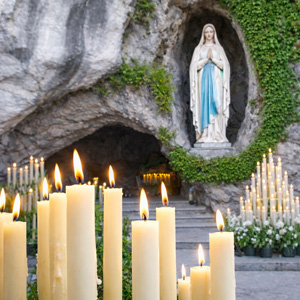
Lighting a candle whilst praying can help us enter into a spirit of contemplation.
Its fragile flame reminds us that faith must be nurtured and protected.
It also evokes the light that we are called to share with those around us.
In some families, an Advent candle is lit for a few moments each day until Christmas.
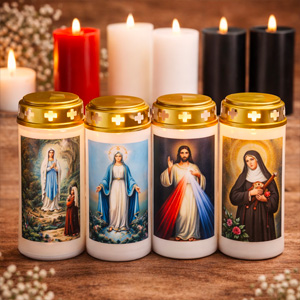
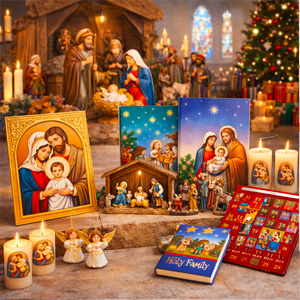
Others choose candles depicting the Virgin Mary, the Holy Family or the Baby Jesus.
These objects possess no magical power: they are physical aids that can accompany prayer and foster a spirit of contemplation.
Their presence invites us to set aside a moment for the Lord amidst our daily busyness.
Advent: a time of hope for those who are suffering
Whilst Christmas is often associated with the joy of family reunions, this period can also be a painful time for some people.
Loneliness, bereavement, illness, financial difficulties or family tensions can make the run-up to the festive season particularly trying.
The season of Advent reminds us that God comes precisely to be with humanity in its fragility.
Jesus is not born in a palace surrounded by riches.
He came into the world in humble circumstances, within a family facing the uncertainties and difficulties of their time.
This birth reveals to us a God who is close to the poorest and most vulnerable.
For those going through a difficult time, Advent can become a time of comfort and hope.
It reminds us that God’s light does not disappear when our lives experience moments of darkness.
It also invites us to pay special attention to those who are isolated.
A simple phone call, a visit or an invitation to share a meal can bring immense comfort.
Preparing for Christmas then takes on its full meaning: welcoming Christ by also welcoming those who need our love.
How can we experience Advent as a family with the children?
Advent is a special opportunity to pass on the faith to the youngest members of the family.
Children are naturally drawn to the lights, carols, traditions and stories surrounding Christmas.
These elements can serve as wonderful tools to help them discover the Christian meaning of the festival.
Setting up the nativity scene together allows you to gradually tell the story of Jesus’ birth.
Each figure can be the starting point for a brief explanation tailored to the children’s age.
Lighting the candles on the Advent wreath each Sunday can also become a family ritual that is eagerly anticipated.
Parents can lead a short prayer, read a passage from the Gospel or invite each child to share a prayer intention.
It is also possible to encourage children to do a good deed every day.
Sharing a toy, helping out at home, comforting a friend or thanking someone are all practical ways of preparing one’s heart for Christmas.
These simple gestures show that the Christian faith is not limited to words.
It is lived out through love, sharing and caring for others.
A prayer to mark the beginning of Advent
Lord Jesus,
As the season of Advent draws near,
We open our hearts to your coming.
In the stillness of our days,
Teach us to recognise your presence.
When our lives are turbulent,
Grant us peace and confidence.
When our hearts are weary,
Kindle within us the light of hope.
Help us to prepare for Christmas
with simplicity, love and generosity.
Following the example of the Virgin Mary,
teach us to accept your will.
Following the example of Saint Joseph,
Grant us the courage to trust in you.
May our homes become places of peace,
May our families grow in unity,
And may our actions bear witness to your love.
Lord Jesus,
Come and dwell in our hearts,
And prepare us to celebrate with joy
The mystery of your holy birth.
Amen.
Christmas is drawing near: let us make our hearts a manger to welcome Jesus
As the first Sunday of Advent approaches, we are invited to rediscover the beauty of a profoundly Christian sense of anticipation.
Over four weeks, the Bible readings, prayers, candles and family traditions will gradually lead us towards Christmas Eve.
But beyond these visible signs, what really matters is the preparation of our hearts.
For Christ does not come merely to remind us of a past event.
He also wishes to find a place in our lives today.
He comes to share in our joys, our wounds, our hopes and our struggles.
He calls us to live more fully in love, trust and forgiveness.
During this Advent season of 2026, let us therefore take the time to slow down and rediscover what truly gives meaning to Christmas.
May every lit candle remind us of the light of Christ.
May every prayer draw us closer to his presence.
May every act of charity help his love to grow around us.
And when Christmas Eve comes, may we welcome the Baby Jesus with a renewed heart, filled with peace and hope.
For the finest gift we can offer the Lord is an open heart, ready to love Him and to welcome His light.