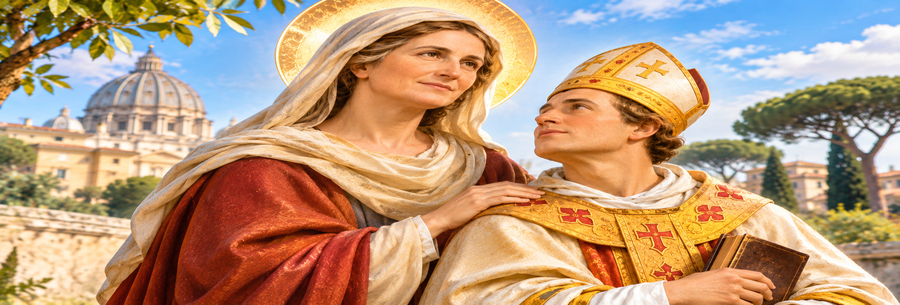
Every year on 5 November, the Catholic Church honours Saint Sylvie of Rome, a woman of faith from the 6th century, known for being the mother of one of the greatest popes in history: Saint Gregory the Great.
Although her name is less well known than that of many martyrs, apostles or great religious founders, Saint Sylvie nevertheless holds a special place in Christian tradition. Her life reminds us that holiness is not manifested solely through extraordinary deeds, but also in the simple acts of daily life, the upbringing of children, faithfulness to prayer and selfless love.
A wife, mother and woman deeply devoted to God, she devoted much of her life to her family before turning more fully towards a life of contemplation and penance.
Her example is particularly valuable for parents, grandparents and all those who wish to pass on the faith to future generations.
Through her story, we discover how a humble and unassuming life can exert a considerable spiritual influence and contribute, quietly, to the history of the Church.
Who was Saint Sylvie of Rome?
Saint Sylvie, also known as Silvia of Rome, lived in the 6th century, a period of profound political, social and religious upheaval.
She belonged to a high-ranking Roman family, in a society still marked by the legacy of the Roman Empire.
At that time, Rome had lost much of its political power. Italy was experiencing wars, invasions, economic hardship and instability that profoundly affected the population.
Despite these upheavals, the Christian faith continued to flourish and the Church played a vital role in the lives of the people.
It was against this backdrop that Saint Sylvie grew up and lived.
The historical records that have survived concerning her are relatively few. Her memory has been passed down to us mainly through Christian tradition and through accounts relating to her son, the future Pope Gregory I.
She married a Roman nobleman named Gordian, with whom she founded a family deeply committed to the faith.
From this union was born, amongst others, Gregory, who would become one of the most important figures in the Western Church.
But to reduce Saint Sylvie to her role as the mother of a great pope would be to overlook the essence of her witness.
She was, above all, a Christian whose faith was expressed through a life of prayer, fidelity and charity.
A Christian family in the service of God
Saint Sylvie’s family belonged to a social circle in which education, public responsibilities and religion played an important role.
Her husband, Gordian, held a position within the Roman administration.
Their home was characterised by a strong Christian tradition and respect for the teachings of the Church.
Saint Sylvie understood that a child’s upbringing should not be limited to imparting knowledge or preparing them for a career.
It should also teach them to distinguish between right and wrong, to develop their conscience, to respect others and to recognise God’s presence in their lives.
From this perspective, the family became a true school of faith.
Prayer, charity and care for the most vulnerable were essential values.
This vision of family life echoes the words of Scripture:
‘As for me and my household, we will serve the Lord.’ (Joshua 24:15)
For Saint Sylvie, serving God did not necessarily mean leaving the world or performing spectacular deeds.
It was, first and foremost, a matter of living each day faithfully fulfilling her responsibilities, making her home a place of love, peace and spiritual guidance.
Saint Sylvie, mother of Saint Gregory the Great
The name of Saint Sylvie is inextricably linked with that of her son, Saint Gregory the Great, who became Pope in 590.
Gregory was born around 540 into a wealthy and cultured Roman family.
He received an excellent education, which enabled him to hold high civil office before choosing a life entirely devoted to God.
In particular, he held the office of Prefect of Rome, one of the city’s most important positions.
However, despite the prospects of a brilliant career, he gradually decided to renounce his honours to embrace monastic life.
He converted part of the family home on the Caelian Hill in Rome into a monastery dedicated to Saint Andrew.
This decision bears witness to the depth of his religious vocation.
The faith he received within his family certainly helped to shape his spiritual sensibility, although it would be impossible to attribute his entire life’s journey solely to his mother’s influence.
Saint Sylvia had taught him, by her example, the importance of prayer, detachment from worldly riches and service to God.
Once he became Pope, Gregory the Great played a major role in the development of the Church.
He encouraged evangelisation, reorganised certain charitable works, developed pastoral teaching and left behind numerous spiritual writings.
His pontificate left a lasting mark on the history of Western Christianity.
Through this exceptional life story, Christian tradition also recognises the value of the upbringing he received in his childhood.
Saint Sylvie thus reminds us that a mother’s words, prayers and actions can bear spiritual fruit far beyond what she could ever imagine.
A mother attentive even in the smallest of gestures
One of the most touching accounts concerning Saint Sylvie speaks of her constant care for her son.
According to tradition, whilst Gregory was leading a monastic life, his mother continued to look after his health and diet.
She took care to send him fresh fruit and vegetables, carefully selected from the markets of Rome.
This detail may seem insignificant when one considers the historical importance of the future pope.
Yet it reveals an essential dimension of Christian charity.
Saint Sylvie did not necessarily seek to perform visible acts of charity or to gain any particular recognition.
She expressed her love through concrete, simple and regular acts.
Preparing a meal, caring for a sick person, showing concern for a loved one’s health or offering a reassuring presence are all expressions of Christian love.
In the Gospel, Jesus teaches:
‘Whenever you did this for one of the least of these my brothers and sisters, you did it for me. ’ (Matthew 25:40)
This passage helps us to understand the spiritual depth of ordinary acts.
Charity is not measured solely by the apparent grandeur of an action.
It is also recognised by the love with which that action is performed.
Saint Sylvie thus teaches us that family responsibilities, when lived out in faith, can become a true path to holiness.
A life of prayer and contemplation
After her husband’s death, Saint Sylvie is said to have gradually adopted a way of life more focused on prayer and penance.
Tradition places this period of her life in the vicinity of Rome, near the Basilica of Saint Paul Outside the Walls.
She is said to have chosen a simple life, far removed from the worldly pleasures and privileges to which her social standing might have given her access.
This spiritual direction was in keeping with a significant movement within Christianity at that time.
Many men and women sought to deepen their relationship with God through prayer, fasting, meditation and detachment from material possessions.
For Saint Sylvie, this approach did not mean renouncing her love for her family.
On the contrary, it enabled her to experience that love in a more profoundly spiritual dimension.
Prayer became a way of entrusting her loved ones to the Lord and of accompanying them beyond her physical presence.
This attitude reminds us that Christian love is not limited to visible acts.
It can also be expressed through silence, intercession and trust in God.
A mother’s prayer: a precious spiritual legacy
The story of Saint Sylvie invites us to reflect on the place of prayer in family life.
Many parents wish to pass on strong values to their children, but sometimes wonder how to support them on their spiritual journey.
The life of Saint Sylvie offers a simple answer: faith is passed on first and foremost by example.
A child may forget certain words, but they often retain a deep memory of the attitudes of those who raised them.
Seeing one’s parents pray, forgive, help someone in need or show patience can be a more powerful lesson than a long speech.
Family prayer also helps to create moments of fellowship and trust.
It can take very simple forms: a prayer before a meal, an intention entrusted to the Lord, a candle lit for a loved one, or a few moments of silence before a religious image.
These gestures, repeated with sincerity, help to nurture faith within the home.
Saint Sylvie thus reminds parents and grandparents that their spiritual mission does not end when their children become adults.
They can continue to support them through their love, advice and prayers.
The role of women in passing on the Christian faith
The example of Saint Sylvie also highlights the vital role played by women in the history of Christianity.
Whilst historical accounts often focus on popes, bishops, missionaries or great theologians, many women have made a decisive contribution to the transmission of the faith.
Some founded religious communities, whilst others devoted their lives to the poor, the sick or education.
Still others, such as Saint Sylvie, exerted their influence primarily within their own families.
This mission may seem unassuming, but it is of considerable importance.
The Christian faith has been passed down through the centuries thanks to parents and grandparents who taught their children to pray, to know the Gospel and to love God.
Saint Sylvie is part of this long tradition.
Her story echoes that of many other saints, notably Saint Monica, mother of Saint Augustine, who also remains a great example of perseverance in prayer for her children.
These women remind us that holiness can flourish amidst family responsibilities and that maternal love can become a true spiritual vocation.
Saint Sylvie and holiness in everyday life
One of Saint Sylvie’s most valuable lessons lies in the ordinary nature of her life.
Unlike some saints known for their missionary journeys, miracles or martyrdom, she left no record of great public deeds.
Her life was devoted chiefly to her family, to prayer and to Christian faithfulness.
Yet the Church continues to honour her memory more than fourteen centuries after her death.
Why?
Because holiness does not depend on fame, power or the recognition of others.
It is based on the love of God and the way in which that love transforms our lives.
Every Christian is called to holiness, whatever their family situation, profession or responsibilities.
A mother who cares for her children, a father who works honestly, someone who looks after a sick relative, or a grandparent who prays for their family can all live out a true Christian vocation.
Saint Sylvie invites us to recognise the spiritual value of these often unseen acts.
She reminds us that God sees what is done in the secret of our hearts.
Why is Saint Sylvie celebrated on 5 November?
Saint Sylvie is traditionally honoured on 5 November in several Catholic calendars and traditions.
Her name also appears in the Roman Martyrology on 3 November, which explains the differences one may encounter depending on the calendar.
Her death is generally thought to have taken place around the year 590, although ancient sources do not allow the exact date to be established with certainty.
Her veneration gradually grew due to her reputation for piety and her connection with Saint Gregory the Great.
In Rome, several sites preserve the memory of Gregory’s family and of Saint Sylvie’s presence.
Christian tradition has thus passed on her example through the centuries, making her a particularly endearing figure of family holiness.
5 November provides a wonderful opportunity to reflect on her witness and to pray for all families.
Why pray to Saint Sylvie?
The faithful may ask for Saint Sylvie’s intercession for their children, grandchildren and loved ones.
Her example is particularly inspiring for mothers who wish to guide their families in the faith.
She may also be invoked when family relationships are facing difficulties, when parents are worried about their children’s future, or when a family wishes to find greater peace and unity.
Praying to Saint Sylvie does not mean attributing to her a power independent of God.
In the Catholic tradition, seeking the intercession of a saint means asking them to pray to the Lord on our behalf.
This practice forms part of the communion of saints, which unites the members of the Church spiritually.
Through Saint Sylvie, we can thus entrust our family concerns to God and ask for the grace to love with greater patience, trust and generosity.
What does Saint Sylvie teach us today?
Saint Sylvie’s witness remains deeply relevant today.
In a society where families are often faced with a lack of time, material concerns and relationship difficulties, her life invites us to rediscover what is essential.
First and foremost, she reminds us that true love is shown through daily care.
It is not always necessary to perform great deeds to show one’s affection.
An encouraging word, a listening ear or a gesture of tenderness can transform someone’s day.
Saint Sylvie also teaches us the importance of patience.
Bringing up children and passing on the faith take time. Results are not always immediate, and everyone must be free to follow their own path.
Her example encourages us to share our beliefs gently, whilst respecting everyone’s freedom and conscience.
Finally, she reminds us that prayer is a source of strength in times of uncertainty.
When we cannot resolve all the difficulties faced by our loved ones, we can continue to love them, support them and entrust them to the Lord.
How can we celebrate Saint Sylvie as a family?
The feast day of Saint Sylvie, on 5 November, can be a wonderful opportunity to share a moment of spirituality as a family.
You could set aside a few minutes to pray for parents, children and grandparents.
You could also read together a passage from the Gospel about loving one’s neighbour or family life.
This day can be an opportunity to thank someone who has played an important role in our upbringing or in our spiritual journey.
A phone call to an elderly parent, a visit to a grandparent or showing special consideration to someone who is isolated can all be lovely acts of charity.
The feast of Saint Sylvie invites us above all to recognise God’s presence in the simplest aspects of our lives.
By caring for one another, we nurture love within our families and respond, in our own way, to Christ’s call.
Prayer to Saint Sylvie for the protection and unity of families
O Saint Sylvie,
You who devoted your life to God and to your family,
You who passed on the faith with love and faithfulness,
We turn to you with confidence.
Intercede with the Lord for our families,
Protect our children and grandchildren,
Guide their steps along the path of truth,
And help them to grow in faith and hope.
Saint Sylvie,
Teach us to love with patience and generosity,
To forgive when difficulties divide us,
To listen gently to those around us,
And to make our homes places of peace.
You who supported your son through prayer,
Support parents who are worried about their children,
Comfort mothers who are going through trials,
And bring hope to families in suffering.
Help us to recognise God’s presence
in the simple acts of our daily lives.
May our words be imbued with kindness,
May our actions bear witness to our faith,
And may our hearts remain open to the love of Christ.
Saint Sylvie, pray for us and for all our families.
Amen.
Saint Sylvie, an example of faith and love to be passed on to future generations
The story of Saint Sylvie shows us that a seemingly unassuming life can leave an immense spiritual legacy.
This 6th-century Christian mother sought neither glory nor honours. She lived out her faith within her family, through prayer, care for others and faithfulness to God.
Her son, Saint Gregory the Great, would go on to become one of the Church’s greatest figures, but Sylvie’s holiness is not measured solely by his exceptional destiny.
It is recognised, above all, in her own way of living out the Gospel.
Her witness invites us to place greater value on simple acts, family ties and shared moments of prayer.
It also reminds us that passing on the faith depends not only on words, but above all on the example we set.
On this 5 November, the feast day of Saint Sylvie, let us take the time to entrust our families to the Lord.
Let us pray for parents who bear heavy responsibilities, for children growing up in a world that is sometimes uncertain, for grandparents who pass on their experience, and for all those who suffer from loneliness or family divisions.
Following the example of Saint Sylvie, let us learn to make our homes places of trust, forgiveness and charity.
For holiness often begins where we live, in the small acts of kindness we show each day, when we choose to love sincerely and to place God at the heart of our lives.