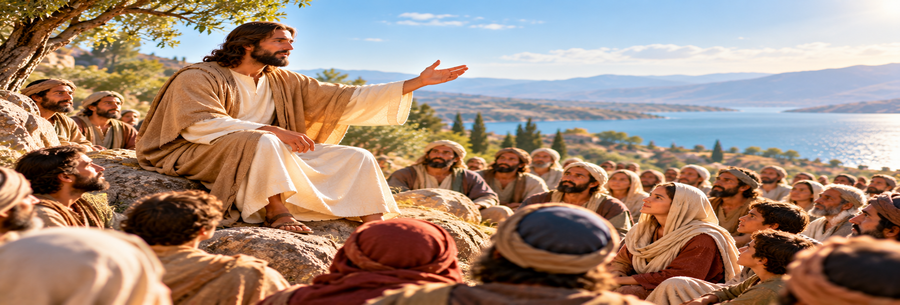
What is true happiness according to Jesus? Is it possible to find inner peace amidst life’s trials, poverty, injustices and suffering? Through the Beatitudes, delivered during the famous Sermon on the Mount, Jesus Christ reveals to us a vision of happiness that is profoundly different from that offered by the world.
In the Gospel according to Saint Matthew, chapter 5, verses 1 to 12, Jesus proclaims the eight Beatitudes, which constitute one of the most important teachings of the entire Christian faith.
‘Blessed are the poor in spirit, for theirs is the kingdom of heaven. ’ (Matthew 5:3)
These words may come as a surprise. How can the poor, those who mourn, the persecuted or those who suffer injustice be declared blessed?
To understand this teaching, we must realise that the happiness of which Jesus speaks does not depend solely on the circumstances of our lives, but on our relationship with God and our hope in the Kingdom of Heaven.
The Beatitudes are not merely words of wisdom. They represent the heart of the Gospel and paint a picture of the true disciple of Christ.
They also show us the face of Jesus Himself, who lived in humility, gentleness, mercy and love, even to the point of giving His life completely.
Let us discover together the meaning of each of the eight Beatitudes, their spiritual significance and how they can transform our daily lives.
1. The Sermon on the Mount: the context of the Beatitudes
The Gospel according to Saint Matthew places the Beatitudes at the beginning of the Sermon on the Mount, which spans chapters 5 to 7.
Jesus has just begun his public ministry in Galilee. He proclaims the nearness of the Kingdom of God, teaches in the synagogues and heals many sick people.
His reputation attracts crowds from different regions.
St Matthew reports:
‘When Jesus saw the crowds, he went up the mountain. He sat down, and his disciples came to him. ” (Matthew 5:1)
This scene has profound biblical significance.
In the Old Testament, the mountain is often a special place of encounter with God.
It was notably on Mount Sinai that Moses received the divine Law.
By depicting Jesus teaching on a mountain, Saint Matthew emphasises the special authority of his teaching.
Christ does not come to abolish God’s Law, but to fulfil it and reveal its full depth.
He does not merely lay down external rules.
He calls for an inner transformation of the heart.
The Beatitudes open this teaching by presenting the spiritual dispositions that characterise those who welcome the Kingdom of God.
They thus constitute a true introduction to the Christian life.
2. What does the word ‘Beatitude’ mean in the Bible?
The term ‘Beatitude’ comes from the Latin beatitudo, which denotes a state of profound happiness or bliss.
In the Gospels, the Greek word makarios is generally translated as ‘happy’ or ‘blessed’.
But the happiness proclaimed by Jesus is not merely a pleasant feeling or a fleeting satisfaction.
It is a happiness rooted in the presence of God and in the promise of his Kingdom.
The Beatitudes do not imply that suffering is good in itself or that difficulties should be sought out.
Jesus glorifies neither misery, nor tears, nor persecution.
He proclaims that God remains close to those who are going through these trials and that their suffering will not have the final say.
The Beatitudes therefore have both a present and a future dimension.
Even now, the believer can discover God’s peace in the midst of difficulties.
But the fullness of the promised happiness will be realised in eternal life.
Christian happiness does not consist in never suffering, but in knowing that God’s love is stronger than suffering and death.
3. First Beatitude: ‘Blessed are the poor in spirit’
‘Blessed are the poor in spirit, for theirs is the kingdom of heaven. ’ (Matthew 5:3)
The first Beatitude holds a fundamental place.
It introduces the whole of Jesus’ teaching and reveals to us the importance of humility.
Being poor in spirit does not necessarily mean lacking material possessions.
This expression refers, above all, to an inner attitude.
The poor in spirit recognise that they cannot achieve everything through their own strength alone.
They know that they need God.
Unlike the proud, who think they are self-sufficient, the poor in spirit welcome divine grace with confidence.
They do not base their worth on their wealth, success or reputation.
They understand that their true wealth lies in the love of God.
This Beatitude also invites us to reflect on our relationship with material possessions.
Possessions are not bad in themselves.
But they become an obstacle when they take up all the space in our hearts.
Christians are called to use what they possess responsibly, justly and generously.
They must remain free inwardly.
Poverty of heart thus teaches us to thank God for what we receive and not to become overly attached to fleeting things.
To be poor in spirit is to recognise that God is our greatest wealth.
4. Second Beatitude: ‘Blessed are those who mourn’
‘Blessed are those who mourn, for they shall be comforted. ’ (Matthew 5:4)
These words may seem paradoxical.
How can Jesus declare those who mourn to be blessed?
To understand this Beatitude, we must distinguish between suffering itself and the divine promise that accompanies it.
Jesus is not saying that tears are pleasant or that sadness should be sought after.
He proclaims that God does not abandon those who suffer.
Tears can have many causes: the loss of a loved one, illness, loneliness, injustice, family difficulties or regret over one’s own faults.
In each of these situations, the Christian faith reminds us that God knows our wounds.
Jesus Himself wept at the death of his friend Lazarus.
He experienced anguish in the Garden of Gethsemane and the suffering of the Passion.
Christ, therefore, does not view human suffering from a distance.
He has personally experienced it.
The promise of consolation does not mean that all our difficulties will disappear immediately.
It assures us that suffering is not the final end of our existence.
In the Christian faith, this hope finds its fulfilment in the Resurrection and eternal life.
This Beatitude also calls us to become instruments of consolation.
Visiting a sick person, supporting a bereaved family or listening to someone going through a difficult time are concrete ways of showing God’s tenderness.
5. Third Beatitude: ‘Blessed are the meek’
‘Blessed are the meek, for they shall inherit the earth.’ (Matthew 5:5)
In our society, meekness is sometimes confused with weakness.
We often admire people who are able to assert themselves, defend their interests and assert their authority.
Yet Jesus presents meekness as a true spiritual strength.
Being meek does not mean passively accepting all injustices or giving up on defending the truth.
Christian meekness consists in rejecting violence, brutality and pride.
It requires controlling one’s anger and treating others with respect.
Jesus Himself is described as ‘meek and humble of heart’ in the Gospel according to Saint Matthew.
Throughout His public life, He showed this meekness towards sinners, the sick and those who were rejected.
Yet his gentleness did not prevent him from denouncing hypocrisy or defending human dignity.
It is a strength guided by love.
In our daily lives, this Beatitude can be expressed through patience in family conflicts, control over our words, and a refusal to respond to aggression with aggression.
Gentleness enables us to build more just and fraternal relationships.
The true disciple of Christ seeks to overcome evil not through violence, but through the power of love.
6. Fourth Beatitude: ‘Blessed are those who hunger and thirst for righteousness’
‘ ‘Blessed are those who hunger and thirst for righteousness, for they shall be filled.’ (Matthew 5:6)
Here, Jesus refers to two fundamental human needs: hunger and thirst.
These images express an intense, profound and vital desire.
To hunger and thirst for righteousness means to ardently desire that God’s will be done.
In the Bible, righteousness is not limited to obedience to human laws.
It also encompasses faithfulness to God, uprightness of heart and respect for the dignity of others.
Christians are called to seek a righteous life before God.
This involves fighting against lies, selfishness, corruption and injustice.
But this quest also begins within our own hearts.
We cannot call for justice in the world whilst refusing to acknowledge our own faults.
The fourth Beatitude therefore invites us to personal conversion and a concrete commitment to our neighbour.
It reminds us that God sees the injustices that sometimes seem to triumph on earth.
His promise of satisfaction heralds the definitive fulfilment of his justice.
In the meantime, we are called to become architects of this justice in our daily lives.
7. Fifth Beatitude: ‘Blessed are the merciful’
‘Blessed are the merciful, for they shall obtain mercy. ’ (Matthew 5:7)
Mercy lies at the heart of the Christian message.
It refers to that love which bends down to human misery to lift people up, forgive them and restore their hope.
Throughout the Gospels, Jesus manifests the Father’s mercy.
He welcomes sinners, forgives wrongs and restores dignity to those whom society condemns.
The parable of the Prodigal Son offers a particularly moving illustration of this.
The father welcomes his repentant son with joy, without holding his past mistakes against him.
Christian mercy does not mean that evil becomes acceptable.
It does not remove the need for justice nor the responsibility to make amends for wrongs committed.
But it refuses to reduce a person to their faults.
To be merciful is to learn to forgive, to understand human frailties and to come to the aid of those who are suffering.
This attitude can be particularly difficult when we have been hurt.
Forgiveness sometimes requires time, a genuine inner journey and God’s grace.
It does not necessarily mean forgetting the harm suffered or resuming a dangerous relationship.
It consists in gradually seeking to free ourselves from hatred and the desire for revenge.
By welcoming God’s mercy, we are invited to become witnesses to that mercy ourselves.
8. Sixth Beatitude: ‘Blessed are the pure in heart’
‘Blessed are the pure in heart, for they shall see God.’ (Matthew 5:8)
Purity of heart occupies a central place in Christian spirituality.
It is not limited to a particular aspect of morality.
It concerns our entire inner life: our intentions, our thoughts, our desires and the way we love.
A pure heart seeks God with sincerity.
It rejects hypocrisy, lies and duplicity.
It does not seek to appear righteous before others whilst deliberately cultivating evil in secret.
In the Gospels, Jesus regularly emphasises the importance of the heart.
He reminds us that true faithfulness to God is not merely a matter of outwardly observing religious rules.
It requires a profound transformation of our very being.
Purity of heart is also linked to simplicity.
Those who possess a pure heart learn to look upon others without reducing them to objects of interest, desire or power.
They seek to love in truth.
The promise ‘they shall see God’ heralds definitive communion with the Lord in eternal life.
But even now, the purification of the heart enables us to recognise God’s presence in our lives more readily.
Prayer, the sacraments, reading the Gospel and acts of charity help us to progress along this path.
9. Seventh Beatitude: ‘Blessed are the peacemakers’
‘Blessed are the peacemakers, for they shall be called children of God. ’ (Matthew 5:9)
Peace is one of the most precious gifts proclaimed by Christ.
At his birth in Bethlehem, the angels proclaimed peace to all people.
After his Resurrection, Jesus appeared to his disciples, saying: ‘Peace be with you!’
But Christian peace does not simply mean the absence of conflict.
It refers to a right relationship with God, with others and with oneself.
Jesus does not merely say: ‘Blessed are those who love peace.’
He speaks of peacemakers.
This expression emphasises an active responsibility.
Building peace requires effort, patience and, at times, great courage.
Within a family, being a peacemaker may mean fostering dialogue, avoiding hurtful words or seeking reconciliation.
In society, it may involve defending justice, rejecting hatred and promoting respect between people.
True peace cannot be built on lies or injustice.
It must be founded on truth, human dignity and charity.
By becoming peacemakers, the disciples of Jesus bear witness to their belonging to the heavenly Father.
Through their actions, they reveal something of God’s love for humanity.
10. Eighth Beatitude: ‘Blessed are those who are persecuted for righteousness’ sake’
‘Blessed are those who are persecuted for righteousness’ sake, for theirs is the kingdom of heaven. ’ (Matthew 5:10)
The final Beatitude reminds us that following Jesus is not always an easy path.
Christ does not promise his disciples a life free from opposition or difficulty.
On the contrary, He prepares them to face, at times, a lack of understanding, rejection or persecution.
Since the early centuries of Christianity, many believers have suffered because of their faithfulness to Christ.
Some have been imprisoned, exiled or put to death.
The Church honours them as martyrs when they have given their lives as a witness to the faith.
However, this Beatitude does not mean that every criticism or difficulty constitutes religious persecution.
Jesus speaks of those who suffer because of their fidelity to justice and to the Gospel.
Christians are called to defend the truth with humility, without deliberately seeking conflict.
When faced with opposition, they must endeavour to respond with patience and charity.
This Beatitude reminds us that human judgement is not the ultimate measure of our faithfulness to God.
The promise of the Kingdom of Heaven becomes a source of hope for those who remain faithful to Christ despite their trials.
11. ‘Rejoice and be glad’: Jesus’ promise to the persecuted
After proclaiming the eight Beatitudes, Jesus addresses his disciples more directly:
‘ Blessed are you when people insult you, persecute you and falsely say all sorts of evil against you because of me.’ (Matthew 5:11)
Then He adds:
‘ Rejoice and be glad, for your reward in heaven is great!’ (Matthew 5:12)
These words build on the eighth Beatitude.
They show that Christian joy does not depend solely on human recognition.
Those who remain faithful to Christ can retain a deep hope, even when they are going through trials.
This joy is not indifference to suffering.
It springs from the certainty that God remains faithful to his promises.
Jesus also reminds us that the Old Testament prophets faced opposition and persecution.
The disciples thus form part of a long history of faithfulness to God.
Christ invites them to look beyond present difficulties towards the fulfilment of the Kingdom.
12. The Beatitudes: the spiritual portrait of Jesus Christ
The Beatitudes are not merely a list of behaviours to adopt.
They also reveal the way in which Jesus Himself lived.
Christ is poor in spirit, for He lives in total trust in His Father.
He is meek and humble, as He declares in the Gospel.
He is merciful towards sinners and those who are rejected.
He has a perfectly pure heart, entirely turned towards the divine will.
He is a peacemaker, for He comes to reconcile humanity with God.
He hungers and thirsts for righteousness, for His entire mission reveals the truth and love of the Father.
He knows tears, particularly at the death of Lazarus and over Jerusalem.
Finally, He accepts persecution and the Passion out of fidelity to His mission of salvation.
Thus, the Beatitudes reveal the face of Christ.
They invite us to become more like Him little by little.
The Christian life is not merely about admiring Jesus.
It consists of following in His footsteps and allowing His Spirit to transform our hearts.
To live out the Beatitudes is to learn to love, to forgive and to hope as Jesus did.
13. The Beatitudes and holiness in the teaching of the Catholic Church
The Catholic Church regards the Beatitudes as a central teaching of the Christian life.
The Catechism of the Catholic Church devotes paragraphs 1716 to 1729 to them in particular.
It explains that they respond to the natural desire for happiness present in the human heart and direct that desire towards God.
The Beatitudes reveal to us the ultimate vocation of humankind: to live in communion with the Lord.
They also shed light on the moral choices we are called to make.
They invite us to choose love over selfishness, truth over falsehood, and fidelity to God over fleeting temptations.
Pope Francis particularly emphasised this teaching in his apostolic exhortation Gaudete et Exsultate, published in 2018 and devoted to the call to holiness in today’s world.
In it, he presents the Beatitudes as a practical path to holiness in everyday life.
Holiness is not reserved for a few extraordinary people.
It is the vocation of all the baptised.
A parent, a worker, an elderly person, someone who is ill or a young person can live out the Beatitudes according to the circumstances of their lives.
Holiness often begins with the simplest of actions, carried out with faith and love.
14. How can we live out the eight Beatitudes in our daily lives?
The Beatitudes may seem difficult to put into practice.
Yet they are directly relevant to our everyday lives.
Living in poverty of spirit means recognising our limitations and not making wealth our sole source of security.
Receiving God’s consolation invites us to entrust our sufferings to Him and to stand by those who mourn.
Practising gentleness means learning to control our anger and to respect others, even when we disagree.
Hungering and thirsting for justice drives us to act with honesty and to defend human dignity.
Being merciful requires us to forgive and to come to the aid of the vulnerable.
Cultivating purity of heart means seeking sincerity, faithfulness and uprightness in our intentions.
Becoming peacemakers invites us to foster dialogue and reconciliation.
Finally, remaining faithful to Christ in the face of opposition teaches us to place our trust in God’s promises.
We do not need to succeed perfectly in all these areas right now.
The Christian life is a journey of gradual conversion.
Every day offers us new opportunities to move forward.
We can start by choosing one of the Beatitudes and seeking to live it out more consciously over the course of several days.
Prayer, examination of conscience and the sacraments help us to make progress.
The Beatitudes are not an unattainable ideal: they are a path we walk with God’s grace.
15. Why are the Beatitudes still essential today?
More than two thousand years after they were proclaimed, the Beatitudes remain remarkably relevant.
Our society often values wealth, achievement, individual success and social recognition.
Happiness is sometimes presented as the result of possessions, comfort or popularity.
Jesus offers us a different perspective.
He reminds us that human beings cannot find fulfilment solely in material possessions.
We need love, truth, justice, peace and communion with God.
The Beatitudes do not invite us to despise the world.
They teach us to live differently at the heart of the world.
They encourage us to pay particular attention to the vulnerable, to reject violence and to seek reconciliation.
They also teach us that our dignity does not depend on our social status.
A person who is poor, sick or suffering remains infinitely precious in God’s eyes.
In a world marked by divisions, conflicts and anxieties, the Beatitudes represent a call to build a more fraternal society.
They remind us that true happiness grows when we learn to love.
16. Frequently asked questions about Jesus’ Beatitudes
What are the eight Beatitudes in the Gospel according to Saint Matthew?
The eight Beatitudes proclaim blessed the poor in spirit, those who mourn, the meek, those who hunger and thirst for righteousness, the merciful, the pure in heart, the peacemakers and those who are persecuted for righteousness’ sake.
Where are the Beatitudes found in the Bible?
The best-known Beatitudes are found in the Gospel according to Saint Matthew, chapter 5, verses 1 to 12, at the beginning of the Sermon on the Mount. The Gospel according to Saint Luke also contains the Beatitudes in chapter 6.
What is the main message of the Beatitudes?
The Beatitudes teach that true happiness is found in communion with God and in a life characterised by humility, justice, mercy, purity of heart and peace.
Why does Jesus say that the poor are blessed?
Jesus does not present poverty as a good in itself. He reveals that those who recognise their need for God can welcome his Kingdom with a humble and open heart.
Are the Beatitudes commandments?
The Beatitudes are not formulated in the same way as the Ten Commandments. They are proclamations of happiness and divine promises, whilst also indicating the spiritual attitudes to which Christ’s disciples are called.
What is the difference between the Beatitudes in Matthew and those in Luke?
Matthew presents eight main Beatitudes, followed by an address to the disciples, whilst Luke records four Beatitudes accompanied by four warnings. Both accounts highlight complementary aspects of Jesus’ teaching.
How can a family live out the Beatitudes?
A Christian family can live out the Beatitudes by cultivating patience, forgiveness, generosity, prayer, mutual respect and care for those in need.
Why are the Beatitudes a path to holiness?
They describe the dispositions of the heart that enable us to become more like Christ. By living them out with God’s grace, Christians grow in love and faithfulness to the Gospel.
17. Prayer for living out Jesus’ Beatitudes
Lord Jesus,
You who proclaimed the Beatitudes on the mountain, open my heart to the beauty of Your teaching.
In a world where I sometimes seek happiness in fleeting things, teach me to discover the true joy that comes from You.
Grant me a poor and humble heart, capable of recognising that I need Your love and Your grace.
When tears and trials come into my life, remind me that You are close to those who suffer and that Your comfort will never fail them.
Teach me gentleness when anger overwhelms me.
Grant me the patience to respond with love when I encounter misunderstanding or injustice.
Let the hunger and thirst for justice grow within me.
May I always seek the truth and respect the dignity of those You place in my path.
Lord, make my heart merciful.
Help me to forgive offences, to understand human weaknesses, and never to close my heart to those in need.
Purify my thoughts, my intentions and my desires.
May I seek You with sincerity and recognise Your presence in the events of my life.
Make me a peacemaker.
May my words soothe conflicts, may my actions foster reconciliation, and may my attitude bear witness to Your love.
When my faith is put to the test, give me the courage to remain faithful to Your Gospel.
Do not let the fear of others’ judgement drive me away from You.
Lord Jesus, You who lived out the Beatitudes perfectly, teach me to follow in Your footsteps every day.
May my life become a testimony of humility, charity, justice and hope.
Jesus, lead me along the path of the Beatitudes, so that I may discover the joy of Your Kingdom today and one day live eternally with You.
Amen.
Conclusion: The Beatitudes: the true path to Christian happiness
The Beatitudes proclaimed by Jesus in the Gospel according to Saint Matthew are among the most enlightening teachings in the entire Bible.
They turn our usual understanding of happiness on its head.
Whilst the world often encourages us to seek wealth, power and recognition, Jesus invites us to discover joy in humility, gentleness, justice, mercy and peace.
The Beatitudes do not promise a life free from difficulties.
They reveal to us that God’s presence can transform the way we endure trials.
They teach us not to despair in the face of suffering, not to respond to violence with violence, and never to give up on love.
They also form a spiritual portrait of Christ, who lived out each of these attitudes to the point of the total gift of his life.
By following his example, we gradually discover that holiness is not reserved for a few exceptional people.
It begins in our daily lives, when we choose to love, to forgive, to share and to trust in God.
Finally, the Beatitudes remind us that our existence has an eternal destiny.
The happiness to which we deeply aspire finds its fulfilment in communion with God.
For true Christian happiness does not consist in possessing ever more, but in learning to love as Jesus did, to live according to his Gospel and to welcome, from today, the promise of his Kingdom.