Among the most moving stories in the Gospel according to Saint Luke, that of Zacchaeus, the tax collector from Jericho, holds a special place. In just ten verses, the evangelist tells us an extraordinary story of curiosity, faith, conversion and divine mercy.
Zacchaeus is a rich, influential man, yet he is deeply shunned by the society of his time. His profession as a tax collector earned him the contempt of his fellow countrymen, who regarded him as a sinner and a collaborator with the Roman occupiers.
Yet, behind his wealth and social standing, Zacchaeus harbours an unexpected desire: to see Jesus of Nazareth.
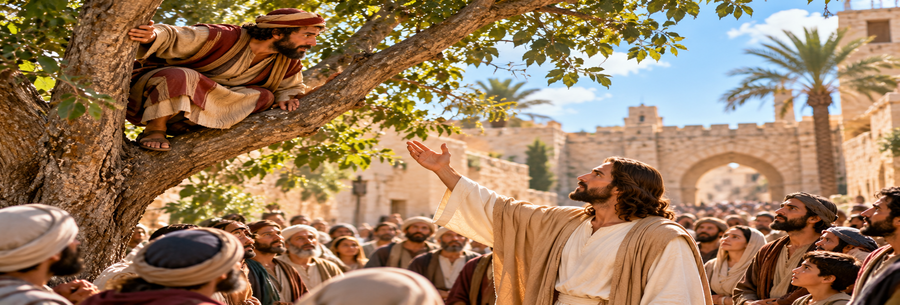
This desire will turn his life upside down. To catch a glimpse of Christ amidst the crowd, he climbs a tree. But what he does not yet realise is that Jesus will not simply pass by him. He will stop, look up, call him by name and ask him to welcome Him into his home.
Through this episode, the Gospel reveals a fundamental truth to us: no one is too far from God to be reached by His love.
Let us explore the story of Zacchaeus in Jericho, its spiritual significance and the lessons it offers us today.
1. Zacchaeus: a rich man, but rejected by others
Who was Zacchaeus in the Gospel?
The evangelist Saint Luke introduces Zacchaeus in a few words:
‘Now there was a man named Zacchaeus; he was the chief tax collector, and he was a wealthy man. ’ (Luke 19:2)
In Jesus’ time, Palestine was under Roman rule. Taxes were collected by local officials working within the tax system imposed by Rome.
These tax collectors, also known as publicans, were often looked down upon by the Jewish population.
They were suspected of charging excessive sums for their own enrichment and of maintaining ties with the Roman authorities.
Zacchaeus was not merely a tax collector. He held an important position, as he was the chief tax collector.
His position had probably enabled him to amass a considerable fortune.
However, his wealth brought him neither the esteem of his fellow countrymen nor the inner peace one might expect from a prosperous life.
The Gospel account does not directly describe his feelings, but it shows us a man prepared to risk ridicule in order to meet Jesus.
Jericho, a prosperous city in Jesus’s time
The encounter takes place in Jericho, an ancient city situated in the Jordan Valley, not far from the Dead Sea.
In Roman times, Jericho was an important city, renowned in particular for its palm groves, its gardens and its production of balm.
Its geographical location made it a commercial crossroads and an economic hub conducive to the collection of taxes.
The presence of a chief tax collector in this city is therefore hardly surprising.
It was against this backdrop of wealth, commercial activity and social tensions that Jesus entered Jericho.
He was then on his way to Jerusalem, where the events of his Passion, death and Resurrection were soon to unfold.
The encounter with Zacchaeus thus takes place at a particularly significant moment in Christ’s earthly mission.
2. Why does Zacchaeus climb a tree to see Jesus?
A desire stronger than the obstacles
Saint Luke explains:
‘He was trying to see who Jesus was, but he could not because of the crowd, for he was a small man.’ (Luke 19:3)
Zacchaeus had heard about Jesus.
Perhaps he was familiar with the stories of his miracles, his healings or his teaching on forgiveness.
The Gospel does not specify what aroused his curiosity.
But one thing is certain: he wants to see Jesus.
Two obstacles stand in his way.
The first is physical: Zacchaeus is short and cannot see Jesus in the midst of the crowd.
The second is social: as a tax collector, he is despised by a large part of the population.
Yet Zacchaeus refuses to give up.
He runs ahead and climbs a sycamore tree so that he can see Jesus pass by.
The sycamore: a tree that has become a symbol of conversion
The Gospel specifies that Zacchaeus climbs a sycamore tree.
This is a tree of the fig family, found in the warm regions of the Near East, notably the sycamore fig (Ficus sycomorus).
Its spreading branches, which were relatively easy to reach, would have allowed a man to climb it.
But beyond this practical aspect, the tree holds deep spiritual significance in Christian meditation.
Zacchaeus must rise above the crowd to catch a glimpse of Jesus.
This physical elevation may symbolise the desire to overcome the obstacles that prevent a person from encountering God.
He momentarily sets aside his social status, his apparent dignity and his habits to satisfy a deeper desire.
A rich and powerful man agrees to behave in a way that might seem strange or ridiculous in the eyes of others.
To meet Jesus, Zacchaeus agrees to stop worrying about what the crowd thinks.
This episode invites us to ask ourselves: are we, too, capable of overcoming our pride, our habits or our fear of others’ judgement in order to draw closer to Christ?
3. Jesus stops and calls Zacchaeus by name
An unexpected encounter
When Jesus reaches the spot where Zacchaeus is standing, He stops.
Instead of continuing on His way, He looks up at the man perched in the tree.
Then He says to him:
‘Zacchaeus, come down quickly: today I must stay at your house. ’ (Luke 19:5)
This sentence lies at the heart of the story.
Zacchaeus simply wanted to see Jesus.
But Jesus desires more: He wants to enter into his life.
Christ does not first ask him to justify his behaviour, to account for his wealth or to prove that he deserves His attention.
He calls him by name.
In the Bible, calling someone by name often signifies a personal relationship and an invitation to respond to God.
Jesus does not merely see a tax collector rejected by society.
He sees a man capable of conversion, a searching heart, a person whom God loves.
‘Today’: the urgency of grace
The word ‘today’ has particular significance in the Gospel according to Saint Luke.
It emphasises that salvation is not merely a distant promise.
God acts in the present.
Jesus does not tell Zacchaeus that He will return once he has changed his ways.
He tells him that He must stay at his house right now.
This initiative on the part of Christ reveals to us that divine grace precedes our transformation.
We do not need to be perfect to begin drawing closer to God.
It is precisely because we are fragile and sinful that we need His mercy.
Jesus does not wait for Zacchaeus to become a righteous man before entering his house. It is His presence that opens the way to conversion.
4. Why does Jesus choose to stay at a sinner’s house?
The crowd’s indignation
When Zacchaeus climbs down from his tree, he welcomes Jesus with joy.
But the crowd’s reaction is very different.
Saint Luke reports:
‘When they saw this, they all grumbled, “He has gone to stay with a man who is a sinner.”’ ’ (Luke 19:7)
To understand this reaction, we must remember the importance of hospitality and sharing meals in first-century Jewish society.
Entering someone’s home and accepting their hospitality could be seen as a sign of closeness and recognition.
Yet Zacchaeus is regarded as a morally impure man, a public sinner.
The crowd does not understand why Jesus, recognised as a religious teacher, would associate with such a disreputable man.
Yet this behaviour is entirely in keeping with Christ’s mission.
Throughout the Gospels, Jesus draws near to the sick, the poor, the marginalised and sinners.
He does not come to condone their faults, but to offer them the chance of a new life.
God’s mercy transcends human judgements
Jesus’ behaviour invites us to reflect on the way we view others.
How often do we judge a person solely on the basis of their past, their reputation or their mistakes?
How often do we think that a man or a woman can never change?
Jesus teaches us that no one should be trapped forever in their faults.
He does not deny the reality of sin, but He always leaves the door open to repentance.
Christian mercy does not mean considering all behaviour to be acceptable.
It consists in believing that God’s grace can transform hearts, even when such a transformation seems humanly improbable.
Where the crowd sees a sinner to be avoided, Jesus sees a person to be saved.
5. Zacchaeus’ conversion: faith expressed through deeds
Zacchaeus decides to share his wealth
The encounter with Jesus immediately bears fruit.
Zacchaeus declares:
‘Look, Lord: I will give half of my possessions to the poor, and if I have defrauded anyone of anything, I will repay them four times over. ” (Luke 19:8)
This declaration is remarkable.
Zacchaeus does not merely express his joy or admiration for Jesus.
He makes concrete commitments.
He decides to give half of his possessions to the poor and to make amends for any injustices he may have committed.
His conversion directly affects the area to which he was probably most attached: money.
The man who had built his social standing on wealth now discovers the value of sharing and justice.
Why does Zacchaeus promise to repay four times as much?
The promise to repay four times the sums unjustly obtained has a special significance.
In biblical tradition, making amends for a wrong is not always limited to returning what was taken.
Certain provisions of the Law of Moses provided for restitution exceeding the value of the stolen goods, depending on the circumstances.
By promising to repay four times as much, Zacchaeus demonstrates a deep desire to right wrongs.
He is not simply seeking to preserve his reputation.
He wishes to restore right relations with those he may have wronged.
This attitude teaches us that true repentance is not limited to words.
It requires, where possible, making amends for the wrong done.
Asking for forgiveness is essential, but Christian conversion also calls for action.
Wealth is no longer his master
Before his encounter with Jesus, Zacchaeus is described as a rich man.
After this encounter, his wealth becomes a means of doing good.
Zacchaeus is not explicitly asked to give up his home or renounce all his possessions.
However, his relationship with money changes radically.
He realises that material possessions are not the ultimate purpose of life.
Money can be used to alleviate poverty, right wrongs and support those in need.
Zacchaeus’ conversion thus shows that it is possible to live in the world whilst placing God at the centre of one’s life.
6. “ Today salvation has come to this house’
An extraordinary declaration by Jesus
After hearing Zacchaeus’s commitments, Jesus declares:
‘Today salvation has come to this house, for he too is a son of Abraham. ’ (Luke 19:9)
These words represent the culmination of the entire encounter.
Zacchaeus was rejected by his fellow countrymen.
Yet Jesus reminds us that he, too, belongs to the people of the Covenant.
His sin had not permanently excluded him from God’s love.
By welcoming Jesus and demonstrating his conversion through his actions, Zacchaeus enters into a renewed relationship with the Lord.
Salvation concerns one’s whole life
When Jesus declares that salvation has come to this house, He is not simply speaking of a change in religious opinion.
The presence of Christ transforms human relationships, behaviour and priorities.
Zacchaeus’s house, once associated with wealth and a profession held in low esteem, becomes the setting for an encounter with divine mercy.
This transformation has both a family and a community dimension.
The salvation proclaimed by Jesus concerns Zacchaeus personally, but his conversion also has consequences for those around him.
Those who may have suffered injustices can now receive redress.
The poor benefit from his generosity.
His home becomes a witness to a new life.
When a person truly welcomes Christ, the fruits of their conversion can radiate far beyond themselves.
7. “ The Son of Man came to seek and to save what was lost”
The account ends with one of the most important sayings in the Gospel according to Saint Luke:
“For the Son of Man came to seek and to save what was lost. ” (Luke 19:10)
This sentence sums up Jesus’ mission.
Christ did not come solely for those who already consider themselves righteous.
He came to seek out those who have strayed from God.
Zacchaeus thus represents humanity, wounded by sin yet still loved by its Creator.
He believed he was the one seeking Jesus.
In reality, the account reveals that Jesus was seeking him too.
This encounter beautifully illustrates the initiative of divine grace.
God never ceases to call humanity back to Him.
Even when we feel unworthy, even when our past weighs heavily upon us, even when others condemn us, Christ’s mercy remains available.
All we need to do is accept His call and embark on a sincere journey of conversion.
8. The five great spiritual lessons from Zacchaeus
First lesson: never give up seeking Jesus
Zacchaeus could have stayed at home, discouraged by the crowd and his short stature.
Instead, he sought a solution and climbed a tree.
His example encourages us to persevere in our search for God, even when obstacles arise.
These obstacles may include a lack of time, personal difficulties, doubts or fear of judgement.
The key is not to let these difficulties extinguish our desire to encounter Christ.
Lesson two: be willing to come down from the tree
Jesus asks Zacchaeus to come down quickly.
In a spiritual reading, this coming down can represent the humility needed to welcome God.
We must sometimes let go of our certainties, our pride or our desire to control everything.
An encounter with Christ requires an open heart.
We cannot truly welcome Jesus whilst refusing to let Him transform our lives.
Third lesson: opening one’s home and heart to Jesus
Zacchaeus welcomes Jesus with joy.
This hospitality is far more than a mere gesture of politeness.
It represents opening one’s life to the divine presence.
Even today, we can welcome Christ into our homes through prayer, reading the Gospel, charity and forgiveness.
The Christian home is called to become a place where God’s love is made tangible.
Fourth lesson: conversion requires action
Zacchaeus does not merely say that he regrets his sins.
He decides to share his wealth and make amends for the injustices he has committed.
His example reminds us that the Christian faith cannot remain purely internal.
It must be expressed through acts of justice, generosity and reconciliation.
True conversion gradually transforms the way we live.
Fifth lesson: no one is excluded from divine mercy
In the eyes of the crowd, Zacchaeus is a sinner unworthy of receiving Jesus.
But Christ looks at him with love and calls him by name.
This attitude is a powerful message of hope.
Whatever our past, we can always return to God.
No sin, when sincerely repented of, is too great for his mercy.
9. What does Zacchaeus teach us about Christian life today?
Zacchaeus’s story remains particularly relevant in a society where material success and social recognition often take centre stage.
Like Zacchaeus, we may be tempted to measure our worth by our possessions, our career or the way others see us.
But the Gospel reminds us that true wealth lies in our relationship with God and in the love we show to our neighbour.
The story also invites us to examine how we use money.
Are we attentive to those in need?
Do we know how to share what we have?
Do we seek to right any wrongs we may have committed?
Are we able to acknowledge our mistakes?
These questions do not apply solely to the wealthy.
They are addressed to every Christian, whatever their circumstances.
Zacchaeus’ conversion also reminds us that the Lord can enter our lives through an unexpected encounter, a word from the Gospel, a trial or an everyday event.
The key is to remain attentive to his presence.
We sometimes look for God far away, when in fact he is already standing at the door of our heart.
10. Frequently asked questions about Zacchaeus in the Gospel
Who was Zacchaeus in the Bible?
Zacchaeus was a rich man who served as chief tax collector in Jericho. He appears in the Gospel according to Saint Luke, chapter 19, verses 1 to 10. His encounter with Jesus brought about a profound conversion.
Why was Zacchaeus hated?
Zacchaeus worked in the tax collection system under Roman rule. Tax collectors were often regarded as collaborators with Rome and suspected of unjust enrichment.
Which tree did Zacchaeus climb?
According to the Gospel of Luke, Zacchaeus climbed a sycamore tree to catch a glimpse of Jesus above the crowd. This tree is traditionally identified as the sycamore fig, a species found in the Near East.
Why did Jesus choose Zacchaeus?
Jesus demonstrated his mission of mercy by approaching a man considered a sinner. He shows that salvation is offered to all those who are willing to repent and accept God’s love.
What is the spiritual significance of Zacchaeus’s tree?
In Christian meditation, the tree can symbolise the desire to rise above obstacles in order to encounter Jesus. Zacchaeus’s descent, at Christ’s call, can also represent humility and openness to grace.
Did Zacchaeus give up all his wealth?
No. The Gospel recounts that he decided to give half of his possessions to the poor and to repay four times the sums he had unjustly taken. The account emphasises the transformation of his relationship with money and his willingness to make amends for the wrongs he had committed.
What is the main message of Luke 19:1–10?
The central message is that Jesus comes to seek and save those who are lost. The encounter with Christ opens a path to conversion, forgiveness, justice and new life.
11. Prayer inspired by the encounter between Jesus and Zacchaeus
Lord Jesus,
Like Zacchaeus, I long to see You and meet You.
But all too often, the concerns of daily life, my weaknesses and my attachments prevent me from recognising Your presence.
Teach me to overcome the obstacles that keep me from You.
Give me the courage to seek Your face, even when the path seems difficult.
Lord, You who looked up at Zacchaeus and called him by name, cast Your merciful gaze upon me today.
Come and dwell in my home and in my heart.
Enlighten my thoughts, purify my intentions and transform my habits.
Deliver me from pride, selfishness and excessive attachment to material possessions.
Teach me to share generously, to right wrongs and to ask for forgiveness when I have hurt my neighbour.
May my faith not be limited to words, but be manifested in my actions.
Lord Jesus, as You did for Zacchaeus, bring Your peace and Your salvation into my home.
May my family grow in love, trust and faithfulness to Your Gospel.
And when I feel lost, remind me that You came to seek and to save those who stray from You.
Jesus, come and dwell in my home today and for ever.
Amen.
Zacchaeus, the sinner who opened his home to salvation
The story of Zacchaeus in Jericho is far more than the tale of a short man who climbed a tree.
It is a magnificent revelation of God’s love for sinners and of the power of conversion.
Zacchaeus was rich, but he lacked what really mattered.
He was seeking to see Jesus, without realising that this encounter would profoundly transform his life.
By agreeing to welcome Christ into his home, he discovered a new kind of wealth: the joy of forgiveness, inner freedom and the happiness of sharing.
His story reminds us that Jesus does not stop at our reputation, our mistakes or our weaknesses.
He looks into our hearts and calls each of us personally to follow Him.
Even today, Christ walks the paths of our lives.
He invites us to come down from our trees, to let go of what separates us from Him, and to open our homes to His presence.
For Zacchaeus’s greatest miracle was not that he managed to see Jesus, but that he allowed himself to be seen, loved and transformed by Him.