Following Jesus Christ is an invitation to transform one’s life, but does that mean one must give up one’s home, family and possessions to become his disciple? This question has spanned the centuries and remains deeply relevant today. In the Gospels, Jesus calls certain men to leave everything behind to follow Him. Yet other disciples continue to live in their homes, amongst their loved ones, whilst placing their faith at the heart of their lives.
What does it really mean to leave everything behind for Jesus? Is it an obligation for every Christian, or a special call addressed to certain people? Through the Holy Scriptures and the teaching of the Catholic Church, let us discover how to respond to Christ’s call without necessarily giving up our homes.
1. Why does Jesus ask certain disciples to leave everything behind?
The calling of the first apostles
In the Gospels, several passages show Jesus inviting men to give up their usual way of life to follow Him.
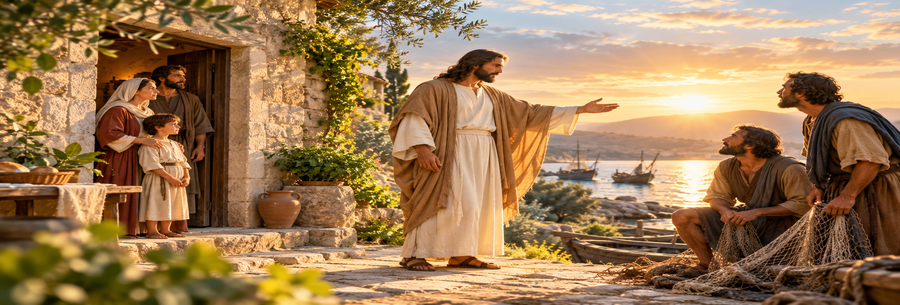
When Jesus meets Simon Peter and his brother Andrew by the Sea of Galilee, He extends this invitation to them:
‘Come, follow me, and I will make you fishers of men. ’ (Matthew 4:19)
The Gospel states that they immediately left their nets to follow Jesus.
A little further on, James and John also left their boat and their father to answer this call.
These men did not merely adhere to a religious teaching. They agreed to radically change their lives to accompany Jesus on his mission.
Their departure symbolises total trust in God. They renounce the security of their trade and their familiar routines to set out on an unknown path.
However, this particular call does not mean that all Christians must abandon their homes or their professions.
The rich young man: a call to detachment
Another particularly illuminating passage is found in the Gospel according to Saint Matthew.
A young man asks Jesus what he must do to gain eternal life. After reminding him of the commandments, Jesus replies:
‘If you wish to be perfect, go, sell what you possess, give it to the poor, and you will have treasure in heaven. Then come, follow me. ” (Matthew 19:21)
The young man goes away sad, for he has great wealth.
This account teaches us a fundamental truth: wealth becomes a spiritual obstacle when it takes first place in our hearts.
Jesus does not condemn the possession of material goods in itself. He warns against excessive attachment to what we own.
A home can be a place of love, prayer and hospitality. But it can also become a source of pride, fear or selfishness if we attach more importance to it than to God.
True renunciation therefore begins in the heart.
2. Can we follow Jesus whilst remaining in our own home?
Jesus was welcomed into the homes of his disciples
The Gospels show that many of Jesus’ disciples owned a home and continued to live there.
In Bethany, Martha, Mary and Lazarus regularly welcomed Jesus into their home.
Their home was a place of friendship, hospitality and spiritual teaching.
In the Gospel according to Saint Luke, Martha is busy with household chores whilst Mary sits at Jesus’ feet to listen to his words.
Jesus then emphasises the importance of the inner life and of listening to God.
This passage does not condemn daily responsibilities. It teaches that our occupations must never make us forget what is essential: our relationship with the Lord.
In this way, a home can become a true place of encounter with Christ.
Zacchaeus: a conversion without leaving one’s home
The story of Zacchaeus is another remarkable example.
Zacchaeus is a wealthy tax collector who wishes to meet Jesus. Jesus says to him:
‘Zacchaeus, come down quickly: today I must stay at your house. ” (Luke 19:5)
This encounter profoundly transformed Zacchaeus.
He decided to give half of his possessions to the poor and to make amends for the injustices he had committed.
Yet Jesus does not ask him to leave his home.
Zacchaeus’s conversion is evident in a change of behaviour, a newfound generosity and a commitment to justice.
This episode reveals that we can become true disciples of Christ by transforming the way we live, without necessarily changing where we live.
3. What does ‘leaving everything behind’ to follow Jesus really mean?
Giving up what distances us from God
When Jesus speaks of renunciation, He invites us above all to reassess our priorities.
He asks us not to let material possessions, personal ambitions or unhealthy attachments take the place that belongs to God.
Following Jesus can therefore mean:
Renouncing pride to learn humility.
Letting go of resentment to choose forgiveness.
Detaching ourselves from money when it becomes an obsession.
Devoting more time to prayer.
Putting love for one’s neighbour before one’s own personal comfort.
Being willing to change certain habits that run counter to the Gospel.
These sacrifices can be demanding, sometimes more so than simply moving house.
For it is possible to leave one’s home in a material sense whilst still harbouring a heart attached to pride, jealousy or selfishness.
Conversely, a person living humbly in their own home may demonstrate deep faithfulness to Christ.
Carrying one’s cross every day
Jesus declares:
‘Whoever wishes to follow me must deny themselves, take up their cross daily and follow me. ’ (Luke 9:23)
These words remind us that the Christian life requires perseverance and faithfulness.
Carrying one’s cross does not mean deliberately seeking out suffering. It means facing life’s difficulties with faith, without giving up on God’s love.
For a parent, this may mean caring for their children with patience.
For someone who is ill, it may mean keeping faith in God in the midst of suffering.
For an elderly or isolated person, it may mean continuing to pray and to love despite loneliness.
Every Christian can follow Jesus in the specific circumstances of their life.
4. Is family a barrier to becoming a disciple of Jesus?
Loving Jesus above all else
Some of Christ’s words may seem particularly demanding.
In the Gospel according to Saint Matthew, Jesus says:
‘Whoever loves their father or mother more than me is not worthy of me.’ (Matthew 10:37)
This statement by no means implies that Jesus is asking us to stop loving our family.
On the contrary, the Church teaches the importance of respect for parents, marital fidelity and family love.
Jesus is simply reminding us that our relationship with God must be the foundation of all our other loves.
When we place Christ at the centre of our lives, we learn to love our loved ones with greater patience, generosity and truth.
God’s love does not destroy family love: it enlightens and deepens it.
Marriage and the family are also paths to holiness
In the Catholic tradition, the vocation to marriage constitutes a true path to sanctification.
Spouses are called to live out their faith through mutual love, fidelity and an openness to life.
Parents pass on the faith to their children through their words, but above all through their example.
A family that prays together, practises forgiveness and cares for the most vulnerable bears concrete witness to the Gospel.
The Holy Family of Nazareth is the most shining example of this.
Jesus Himself grew up in a family home, surrounded by the Virgin Mary and Saint Joseph.
For many years, He shared a simple family life, made up of work, prayer and human relationships.
Jesus’ hidden life in Nazareth teaches us that holiness can grow out of the most ordinary acts of daily life.
5. Why do some Christians nevertheless choose to leave their homes?
The religious and missionary vocation
Whilst not all disciples are called to leave their homes, some people receive a special vocation.
Priests, men and women religious, and some missionaries may be led to leave their homes, their professions or their family environments in order to devote themselves entirely to the service of God.
In religious life, the vows of poverty, chastity and obedience express a radical commitment to following Christ.
This renunciation is not a rejection of the world or of the family.
It represents a particular way of bearing witness that God is the supreme good and that eternal life is our true hope.
The example of Saint Francis of Assisi
Saint Francis of Assisi remains one of the best-known figures of Christian detachment.
Born into a wealthy family, he chose to renounce his riches to live in poverty and devote himself to God.
He found deep joy in simplicity, brotherhood and service to the poor.
His example reminds us that material possessions are not enough to fulfil the human heart.
However, Saint Francis did not ask all the faithful to leave their homes.
Franciscan spirituality has also inspired many lay people who have lived out the Gospel within their families and in their professions.
Holiness therefore takes different forms depending on each person’s vocation.
6. How can we make our home a place where Jesus is present?
It is not necessary to live in a monastery to develop a deep spiritual life.
A Christian home can become a true little domestic church.
Creating a space for prayer
Setting aside a small prayer corner allows you to reserve a place for quiet reflection.
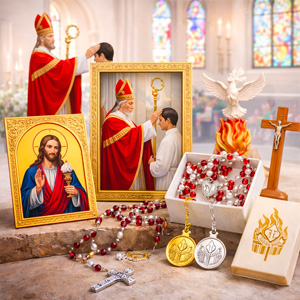
You could place a cross, a Bible, an image of the Sacred Heart of Jesus, a representation of the Virgin Mary or a prayer candle there.
These religious objects never replace inner faith, but they can help us turn our gaze towards God.
Taking a few minutes each morning or evening to pray helps us to maintain a living relationship with Christ.
Reading the Gospels regularly
To become a disciple of Jesus, it is essential to get to know his words.
Reading the Gospels helps us to understand his teaching and to discern how to apply it in our daily lives.
It is not essential to read long passages every day.
A few verses meditated upon carefully can deeply nourish our faith.
Making your home a place of charity
Christ’s presence is also evident in the way we welcome others.
A Christian home can become a place of peace when we cultivate listening, kindness and forgiveness within it.
Welcoming someone who is isolated, helping a neighbour, sharing a meal or supporting a loved one through a difficult time are all acts that bring the Gospel to life.
Jesus reminds us:
‘Whatever you did for one of the least of these brothers and sisters of mine, you did for me. ’ (Matthew 25:40)
In this way, our home can become a place of mission, even without us having to go far away.
7. How can we tell if Jesus is calling us to make a radical change in our lives?
Every vocation is unique.
Some people feel a deep calling to enter religious life, to become priests or to go on a mission.
Others discover that their mission is to bring up their children, to carry out their work with integrity or to serve vulnerable people.
To discern one’s vocation, several approaches are essential.
Prayer: asking the Lord to enlighten us as to the path He wishes for us.
Listening to the Word of God: meditating on the Gospels to better understand Christ’s call.
Spiritual guidance: speaking with a priest or someone qualified to help you discern your vocation calmly.
Patience: avoid hasty decisions and allow inner calls to mature.
Faithfulness to one’s current responsibilities: do not confuse a genuine call from God with the desire to escape the difficulties of daily life.
God does not necessarily ask us to turn our lives upside down overnight.
He invites us first to open our hearts to Him and to move forward with confidence.
8. Frequently asked questions: following Jesus without leaving home
Is it compulsory to leave home to follow Jesus?
No. The Catholic Church does not teach that all Christians must leave their homes or families. Every baptised person is called to follow Christ according to their vocation, whether they live in the world or in a religious community.
Can one become a saint by living an ordinary life?
Yes. Holiness is accessible to everyone. A married person, a parent, a worker or a pensioner can progress towards holiness by living out faith, hope and charity in their daily lives.
Why does Jesus ask us to renounce our possessions?
Jesus warns us against excessive attachment to wealth. He invites us to generosity, sharing and inner freedom. Some people are called to radical voluntary poverty, but this commitment is not imposed on everyone.
Can one follow Jesus whilst being wealthy?
Yes, provided one does not make wealth an idol. Material possessions must be used with justice, responsibility and generosity. The essential thing is to keep one’s heart free and attentive to the needs of others.
How can I tell if God is calling me to leave everything behind?
A call to religious or missionary life requires serious discernment, nourished by prayer and supported by the Church. It is important to ensure that this call is lasting, freely chosen and compatible with the responsibilities one must fulfil.
Can a home become a place of prayer?
Absolutely. The Catholic tradition encourages family prayer, reading the Bible and the presence of religious symbols in the home. A home where people pray, forgive and welcome their neighbours can become a true witness to the faith.
9. A prayer to learn to follow Jesus every day
Lord Jesus,
You called Your first disciples to leave their nets and follow You.
Even today, You invite us to open our hearts to Your love and to make You the centre of our lives.
Teach me to recognise Your voice amidst the concerns of daily life.
Deliver me from the attachments that draw me away from You, from the pride that closes my heart, and from the worries that weaken my trust.
May my home be a place of peace, prayer and charity.
May my words bring comfort, may my actions bear witness to Your goodness, and may my decisions be guided by Your Gospel.
Lord, if You call me to change my path, grant me the courage to respond with faith.
And if You call me to serve You where I am, help me to live each day with love and faithfulness.
May I seek to follow You not only in my words, but with my whole life.
Jesus, make me Your disciple, today and for ever.
Amen.
Conclusion: following Jesus means, first and foremost, putting Him first
So, must one leave one’s home to become a disciple of Jesus?
The answer is no, not necessarily.
Some Christians receive a special call to leave everything behind to devote themselves to God. Others are called to bear witness to their faith within their families, in their professions and in their daily lives.
What matters above all is not where we live, but the place we give to Christ.
Following Jesus means learning to love as He does, to forgive as He does, to serve others and to place our trust in God.
Our home, our family and our activities can become paths to holiness when we live them in the light of the Gospel.
For being a disciple of Jesus does not always mean leaving one’s home, but accepting that Christ transforms our hearts and our way of life.
And perhaps the first step in following Jesus is simply to open the door of our home and our lives to Him today.