In Lourdes, excitement is building as an exceptional event draws nearer. On 26 and 27 September 2026, the Marian town will welcome Pope Leo XIV on his apostolic journey to France.
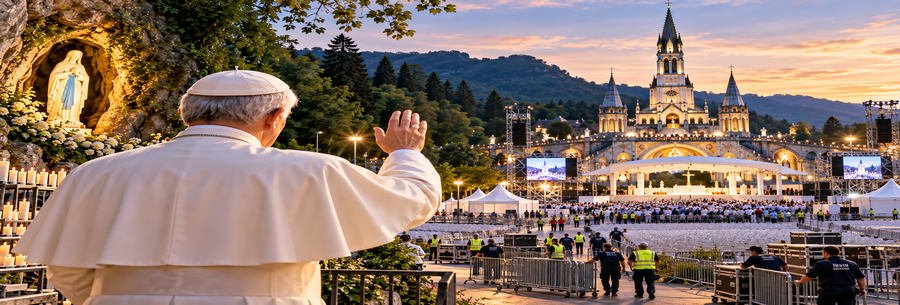
Preparations are now visible both on the streets of Lourdes and at the Sanctuary of Our Lady of Lourdes. Technical installations, barriers, layout of the Prairie, organisation of access routes, preparation of the celebrations, welcoming the sick and pilgrims, security, volunteers, candles, communion wafers, sound systems, giant screens…
Behind the few hours the Holy Father will spend in the Marian town lies, in reality, an exceptional organisation that has been in the making for months.
For welcoming a Pope to Lourdes is not merely a matter of receiving an international figure. For the Sanctuary, it is above all a matter of welcoming a pilgrim who has come to pray at the Grotto of Massabielle, to meet the sick and to share in the faith of tens of thousands of people.
With just a few days to go before his arrival, let’s take a look behind the scenes at these preparations and see how Lourdes is transforming itself to host one of the major events in its recent history.
26 and 27 September 2026: two historic days for Lourdes
Leo XIV will arrive at Tarbes-Lourdes-Pyrénées International Airport on Saturday 26 September at around 7.05 pm.
As soon as he arrives, he will make his way to the Sanctuary.
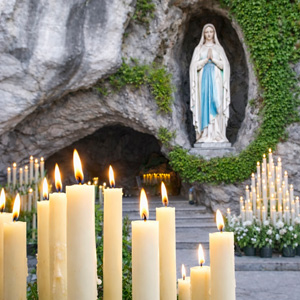
His first engagement in Lourdes will be particularly symbolic: at 7.40 pm, the Pope is due to pray before the Grotto of the Apparitions at Massabielle.
No grand speech to start with.
Leo XIV’s first act in Lourdes will be that of a pilgrim.
In particular, he is due to touch the rock in the Grotto, drink the water of Lourdes, light a candle, kneel and pray in silence.
These are acts carried out daily by thousands of pilgrims.
The day of Sunday 27 September will then be particularly packed with events.
At 9 am, Leo XIV will meet the bishops of France in the Sainte-Bernadette hemicycle.
At 11 am, he will preside over the high Sunday Mass on the Sanctuary Meadow, followed by the Angelus prayer.
At 3.30 pm, the Pope will meet the hospital staff and the sick being cared for at the Accueil Notre-Dame.
He is then due to meet privately with the contemplative nuns of the Carmelite convent in Lourdes.
Finally, at 9.00 pm, one of the most powerful moments of this visit is expected to take place on the esplanade: Leo XIV will take part in the recitation of the Holy Rosary and the famous Marian torchlight procession.
A day devoted almost entirely to prayer, pilgrims and the vulnerable.
150,000 pilgrims expected at the Sanctuary
The scale of the event is measured first and foremost by the number of participants.
The Sanctuary has now announced that it has reached maximum capacity: 150,000 people are expected to pray with the Pope in Lourdes.
Registration to attend the celebrations is now closed.
This exceptional turnout requires considerable organisation.
Arrangements must be made to enable tens of thousands of people to arrive, move about, access the various areas of the Sanctuary and depart in good conditions.
Added to this are the elderly, families with children, pilgrimage groups and, above all, the many sick or disabled people who traditionally play a central role in Lourdes.
The organisers cannot, therefore, leave anything to chance.
Over 10 kilometres of barriers
To manage the movement of this immense crowd, over 10 kilometres of barriers are planned.
These installations make it possible to create different routes, secure certain areas and organise entry and exit points.
The Sanctuary, which covers several dozen hectares, must temporarily adapt a large part of its usual operations.
Traffic in Lourdes is also significantly affected.
In particular, the authorities advise against using vehicles within the city centre of Lourdes between Saturday 26 September at 10.00 am and Monday 28 September at 7.30 am.
The organisation therefore extends well beyond the Sanctuary’s grounds: the whole town must adapt its operations to the Pope’s visit.
The Prairie transformed for the grand Mass
One of the most significant projects naturally concerns the Prairie of the Sanctuary, where Pope Leo XIV will celebrate Mass on Sunday morning.
This vast space, situated on the other side of the Gave, is no stranger to hosting major celebrations.
But a pontifical Mass before a congregation of this size requires special arrangements.
A large podium is being erected for the service.
Its surface area is approximately 600 m², whilst an area with around 400 seats is set aside to accommodate bishops and cardinals.
Nearly 3,000 priests are also expected to attend.
The various sections of the congregation must be organised, liturgical access points planned, support provided for those with mobility issues, and a clear view of the celebration ensured.
Giant screens to follow the celebration
In a crowd of 150,000 people, not everyone can, of course, be in the immediate vicinity of the altar.
More than a dozen giant screens must therefore be installed in various sections.
These will enable pilgrims furthest away to follow the proceedings of the celebration, the readings, Pope Leo XIV’s homily and the Angelus prayer.
The sound system also presents a considerable challenge.
The Pope’s voice, the prayers, the hymns and the readings must be audible throughout all the areas where the faithful are gathered.
Technical teams are therefore working alongside the liturgical teams to ensure that the technology remains unobtrusive whilst enabling everyone to participate fully in the celebration.
400,000 communion wafers prepared
Behind the grand Sunday celebration, there is also much quieter work taking place.
In Lourdes, religious communities play an active part in the preparations.
Throughout the month of September, marked in particular by this exceptional turnout, 400,000 hosts are prepared.
This figure gives a very concrete idea of the scale of the liturgical organisation.
Each host must be made, prepared, packaged and transported before the celebrations.
Behind the large-scale technical installations, therefore, lies a multitude of discreet tasks carried out in silence.
This is perhaps one of the most beautiful aspects of the preparations for Lourdes: the practical organisation and the spiritual preparation go hand in hand.
175,000 candles produced in three weeks
Another unmissable symbol of Lourdes: the candle.
Ever since Bernadette Soubirous, light has played an essential role in the spirituality of the Sanctuary.
Pilgrims light candles every day to entrust an intention, ask for a grace or give thanks for a prayer that has been answered.
With the arrival of Leo XIV and the grand Sunday evening Torchlight Procession, demand increased considerably.
The Lourdes candle factory has planned to produce 175,000 candles in just three weeks, with a production increase of around 20 per cent ahead of the visit.
Behind this impressive figure lies one of the images set to define the weekend: that of thousands of flames illuminating the esplanade whilst the Pope recites the Rosary with the pilgrims.
A monumental cross for the celebration
Some of the preparations also involve art and craftsmanship.
A monumental cross, 6.20 metres high, weighing approximately 200 kilograms, has been specially created for the celebration.
Its size is, of course, tailored to the dimensions of the venue.
In front of a vast assembly, the liturgical symbols must be visible from a great distance.
But above all, this cross serves as a reminder of the primary purpose of all these preparations.
Podia, screens, barriers and technical equipment are merely means to an end.
Christ remains at the centre of the celebration.
Hundreds of volunteers at work
No organisation on this scale would be possible without volunteers.
In Lourdes, volunteering is already part of the Sanctuary’s identity.
Throughout the year, men and women give of their time to welcome pilgrims, support the sick, guide groups and help organise the major pilgrimages.
With the visit of Leo XIV, this effort takes on an extra dimension.
The teams of volunteers planned for the visit are now reported to be fully booked.
Reception, guidance, support, logistics, liturgy: there are many tasks to be carried out.
Working alongside them are the Sanctuary’s staff, seasonal workers, religious communities, hospital staff, technical services and the various public services mobilised for the event.
Exceptional security measures
The visit of a Supreme Pontiff necessarily entails very extensive security measures.
Pope Leo XIV’s visit to France, from 25 to 28 September, has been officially classified as ‘major event’ within the meaning of the Internal Security Code.
In Lourdes, the area concerned includes, in particular, the Sanctuary of Our Lady of Lourdes and several adjacent roads and sites.
Access points, the movement of people and the various areas must therefore be rigorously organised.
These security measures must, however, take into account a key characteristic of Lourdes: the presence of a very large number of vulnerable people.
The challenge is therefore to balance security, smooth flow and a warm welcome.
Nearly 1,000 journalists expected
The event will be followed far beyond Lourdes.
Nearly 1,000 journalists are expected to cover the visit.
Television crews, radio stations, photographers, press agencies and digital media must be able to work on site.
A press centre and dedicated areas must therefore be set up.
Footage of the Grotto, the High Mass and the Torchlight Procession will be broadcast in France as well as in many other countries.
The Sanctuary also points out that, whilst 150,000 people will be able to attend in person, millions more will be able to follow the events via television, radio and digital broadcasts.
Over 3.7 million euros for the organisation in Lourdes
Such a large-scale operation naturally comes at a significant cost.
The resources required to organise the Lourdes leg of the event are estimated at over 3.7 million euros.
Technical installations, temporary structures, reception facilities, security, toilets, screens, logistics: the expenses are numerous.
For Léon XIV’s entire apostolic journey in France — Paris, Lourdes and Metz — the announced budget amounts to approximately 27 million euros.
A call for donations has been launched to help fund this visit.
Preparations carried out in collaboration with the Vatican
The organisation of a papal visit is, of course, not decided solely on the ground.
Teams from the Vatican have been working for several months with the French Bishops’ Conference, the Diocese of Tarbes and Lourdes, the Sanctuary and the public authorities.
In particular, a delegation from the Holy See visited Lourdes in advance to carry out site inspections.
Every papal visit is carefully planned.
The venues for the celebrations are inspected.
The routes are checked.
Matters of security, protocol, liturgy and communication are co-ordinated between the various parties involved.
Behind the Pope’s two-day visit to Lourdes lie months of meetings, site inspections and preparations.
But above all, Lourdes is preparing for a pilgrimage
It would, however, be an oversimplification to view these preparations merely as a massive logistical operation.
For Leon XIV is coming to Lourdes first and foremost as a pilgrim.
This aspect was particularly emphasised by the Bishop of Tarbes and Lourdes, Monsignor Jean-Marc Micas.
When the Pope arrives at the Grotto, he will perform the simple gestures of pilgrims: touching the rock, drinking the water, lighting a candle, kneeling and praying.
This simplicity almost contrasts with the immense resources required to organise his visit.
Kilometres of barriers will have been erected.
Hundreds of people will have been working on it.
Thousands of priests and tens of thousands of pilgrims will have made the journey.
And yet, at the heart of the event will be a man standing in silence before the Grotto of Massabielle.
The sick at the centre of the visit
The stop in Lourdes will naturally give special prominence to the sick.
On Sunday afternoon, Leo XIV is due to meet the hospital staff and those staying at the Accueil Notre-Dame.
This meeting has a strong symbolic significance.
Ever since the first pilgrimages, the sick have occupied a central place in Lourdes.
They are not merely present amongst the pilgrims: they are at the heart of the Sanctuary’s mission.
John Paul II had already attached great importance to meeting them during his visits to Lourdes.
Benedict XVI, too, had celebrated a Mass specifically for the sick during his 2008 pilgrimage.
Leo XIV will thus be following in this long tradition.
The Torchlight Procession as the highlight
Following the High Mass, the meetings and times of prayer, Sunday will conclude with one of Lourdes’ most iconic traditions.
At 9.00 pm, Léon XIV will take part in the recitation of the Holy Rosary and the Marian torchlight procession.
As night falls over the Sanctuary, thousands of candles will be lit.
Pilgrims will recite the Rosary in various languages.
Then the Ave Maria of Lourdes will ring out.
This procession is set to be one of the most striking images of the trip.
A Pope amidst a vast crowd, under the gaze of Our Lady of Lourdes, surrounded by thousands of tiny lights.
A whole town is getting ready
Ultimately, the visit is not just about the Sanctuary.
The whole town of Lourdes is making preparations.
Hoteliers, restaurant owners, shopkeepers, transport operators, municipal services, security forces and residents must cope with an exceptional influx of visitors.
Traffic patterns are altered.
Access is controlled.
Accommodation providers welcome pilgrims, some of whom have travelled from far afield.
For a few days, Lourdes will once again, more than ever, become what it has been since the 19th century: an international pilgrimage hub.
An anticipation that is also spiritual
As the facilities go up and the date draws nearer, another, less visible form of preparation is taking place.
That of the heart.
For believers, welcoming the Pope is not merely about catching a glimpse of Leo XIV or taking part in a large gathering.
The Successor of Peter comes to strengthen his brothers in the faith.
Parishes, religious communities, host families and households are already keeping this visit in their prayers.
Some pilgrims will come to ask for a grace.
Others will bring the intention of a sick loved one.
Still others will come to give thanks.
As always in Lourdes, behind the huge gathering lie thousands of personal stories.
The countdown has begun
With just a few days to go before Leo XIV’s visit to Lourdes on 26 and 27 September 2026, the final preparations are gathering pace.
150,000 pilgrims, over 10 kilometres of barriers, more than ten giant screens, nearly 3,000 priests, 175,000 candles produced in three weeks, 400,000 communion wafers prepared for September and nearly 1,000 journalists expected: the figures give an idea of the scale of the event.
But they do not convey the essence of it.
For behind this colossal organisation, what is being prepared above all is a pilgrimage.
On Saturday evening, when Leo XIV arrives at the Grotto of Massabielle, the noise of the preparations will give way to silence.
The Pope will kneel where, for over a century and a half, millions of people have come to pray.
Then, the following evening, thousands of candles will be lit for the Torchlight Procession.
After months of preparation, Lourdes will then be able to fully experience what the whole town and the Sanctuary have been preparing for:
to welcome the Successor of Peter as a pilgrim amongst pilgrims, under the watchful eye of Our Lady of Lourdes.