Since the apparitions of the Virgin Mary to Bernadette Soubirous in 1858, Lourdes has become one of the world’s greatest Marian shrines. Every year, millions of pilgrims come here to offer their prayers, pray before the Grotto of Massabielle, take part in processions and entrust their joys, sufferings and hopes to Our Lady.
Among these pilgrims are ordinary people from all corners of the world, families, the sick, hospital staff, members of religious orders and priests. But Lourdes has also welcomed several successors of Saint Peter.
From Saint John Paul II to Benedict XVI, and now with the announced visit of Pope Leo XIV in September 2026, the papal pilgrimages to Lourdes bear witness to the special bond that unites the Pyrenean shrine with the universal Church.
A look back at these historic visits and their profound spiritual significance.
Lourdes, a sanctuary at the heart of the Church
It all began on 11 February 1858.
On that day, Bernadette Soubirous, a 14-year-old girl from a very poor family in Lourdes, went to the Grotto of Massabielle. There she saw a ‘Lady’ dressed in white, wearing a blue sash and a yellow rose on each foot.
Between 11 February and 16 July 1858, eighteen apparitions took place.
During these apparitions, the Virgin Mary called for prayer, penance and conversion. On 25 March 1858, she finally revealed her name to Bernadette:
“I am the Immaculate Conception.”
Lourdes gradually became a major place of pilgrimage. People come there to pray to Mary, but always with a view to turning to her Son, Jesus Christ.
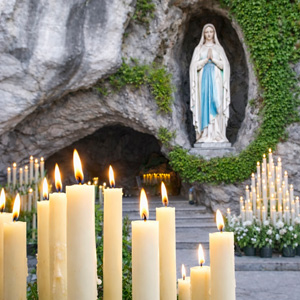
The Grotto, the spring, the processions, the candles, the Rosary and the very special presence of the sick remain, even today, the defining features of Lourdes.
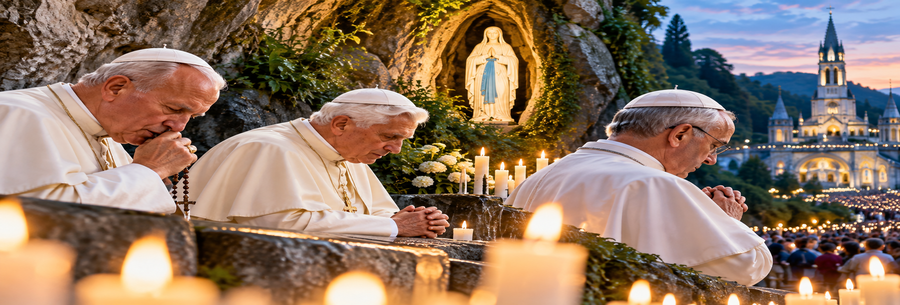
And it is precisely as pilgrims that the popes, too, come to kneel before the Grotto.
John Paul II in Lourdes in 1983: the first papal pilgrimage to the Grotto
On 14 and 15 August 1983, Pope John Paul II made his first apostolic pilgrimage to Lourdes.
This visit took place to mark the 125th anniversary of the apparitions of 1858.
It was of particular historical significance: John Paul II was the first Pope to make a pilgrimage to Lourdes in person.
On his arrival at the Grotto of Massabielle on 14 August, he gave thanks for this place where, in his own words, faith can be renewed, bodies and souls can find healing, and the Church’s purpose can be strengthened.
John Paul II also recalled an event still very much fresh in everyone’s memory: the assassination attempt on 13 May 1981 in St Peter’s Square, which he survived.
His visit to Lourdes thus took on a very personal dimension.
The Polish Pope does indeed have an extremely deep relationship with the Virgin Mary. His papal motto, ‘Totus Tuus’ – ‘All yours’ – expresses this special consecration to Mary.
In Lourdes, John Paul II thus became a pilgrim amongst pilgrims.
He prayed before the Grotto, recited the Rosary, took part in the torchlight procession and met, in particular, with priests, nuns, young people and the sick.
On 15 August, the Solemnity of the Assumption of the Virgin Mary, he celebrated Mass at the Grotto of the Apparitions.
Before leaving Lourdes, John Paul II remarked that he had experienced one of the most beautiful Feast of the Assumption of his life.
Lourdes and the sick: an essential aspect for John Paul II
Meeting with the sick played a particularly important role in this first visit.
This is, of course, no coincidence.
Since its very beginnings, Lourdes has been deeply associated with those who suffer. Every year, thousands of volunteers and carers accompany the sick, the elderly and people with disabilities to the Grotto.
John Paul II emphasised the dignity of those who suffer and their place at the heart of the Church.
This closeness to the sick would take on an even more moving dimension upon his return to Lourdes, twenty-one years later.
John Paul II returns to Lourdes in 2004
On 14 and 15 August 2004, John Paul II returned to Lourdes for a second time.
The context was different.
The Church was then celebrating the 150th anniversary of the proclamation of the dogma of the Immaculate Conception, defined by Pope Pius IX on 8 December 1854.
Just four years after this proclamation, the Lady of Massabielle had declared to Bernadette:
“I am the Immaculate Conception.”
John Paul II was therefore particularly keen to make this pilgrimage.
But this visit will also be remembered for another reason: the Pope was then 84 years old and severely weakened by illness.
The man who, in 1983, had come to speak to the sick now presented himself as a pilgrim marked by physical suffering.
On his arrival at the Grotto, his first words were, in fact, addressed to the sick.
He explained to them that he had come to the Virgin Mary as a pilgrim and that he shared with them a time in his life marked by physical suffering.
This image of John Paul II before the Grotto remains one of the most moving moments of his pontificate.
“This Grotto is the heart of Lourdes”
On 14 August 2004, John Paul II knelt once more near the Grotto of Massabielle.
He described the Grotto as “the heart of Lourdes” and as a true school of prayer.
For him, the message of Lourdes was not merely about asking the Virgin for graces.
Mary always leads us to Christ.
The Rosary thus becomes a contemplation of Jesus with Mary.
During his stay, John Paul II prayed the Rosary, took part in the procession, attended the torchlight procession and, the following day, celebrated the Mass of the Assumption on the sanctuary’s meadow.
This was to be his final trip to France.
Less than eight months later, on 2 April 2005, John Paul II died at the Vatican.
In retrospect, his final pilgrimage to Lourdes thus takes on an even greater significance: that of a man who had almost reached the end of his earthly life, coming once more to entrust his ministry and his sufferings to the Virgin Mary.
Benedict XVI in Lourdes in 2008: the Jubilee of the Apparitions
Four years later, Lourdes once again welcomed a Supreme Pontiff.
From 13 to 15 September 2008, Pope Benedict XVI visited the shrine to mark the 150th anniversary of the apparitions of the Virgin Mary to Bernadette Soubirous.
His apostolic journey to France had begun in Paris. But Benedict XVI himself explained that the main reason for his visit to France was to celebrate the Jubilee of the Apparitions at Lourdes.
For Joseph Ratzinger, Lourdes was not entirely unfamiliar territory.
Before becoming Pope, he had visited the town in 1981, on the occasion of the International Eucharistic Congress, shortly after the assassination attempt on John Paul II.
Now as Benedict XVI, he therefore returned to Lourdes as the Successor of Peter.
In the footsteps of Bernadette
Benedict XVI’s pilgrimage has a distinctive feature: the Pope follows the Jubilee Route, which takes in several key sites in Bernadette’s life.
In particular, it takes him past the baptismal font where she was baptised, the ‘Cachot’ where the Soubirous family lived in great poverty, and, of course, the Grotto of Massabielle.
Benedict XVI also takes part in one of the most iconic moments in Lourdes: the Marian torchlight procession.
On the evening of 13 September 2008, he reflected on the apparitions and recalled the great messages conveyed to Bernadette: prayer, penance and conversion.
The following day, 14 September, the feast of the Exaltation of the Holy Cross, he celebrated Mass on the meadow at the sanctuary.
This liturgical coincidence allowed the Pope to highlight a fundamental aspect of the spirituality of Lourdes: Mary never draws attention to herself; she always leads us to Christ.
Benedict XVI and the sick at Lourdes
On 15 September 2008, the feast of Our Lady of Sorrows, Benedict XVI celebrated a Mass especially intended for the sick.
Here too, the choice of date carries great symbolic significance.
Mary is contemplated as the Mother standing at the foot of the Cross, sharing in her Son’s suffering.
In Lourdes, where so many people come with their illnesses, their wounds and their worries, this maternal presence takes on a special meaning.
A few days after his return to Rome, Benedict XVI described Lourdes as a place of light, prayer, hope and conversion.
And what of Pope Francis?
Between Benedict XVI’s visit in 2008 and the announced visit of Pope Leo XIV in 2026, Pope Francis has not made an apostolic journey to Lourdes.
His pontificate has, however, been deeply marked by Marian devotion, particularly to Our Lady Who Unties Knots, and by his numerous pilgrimages to Marian shrines.
Lourdes has also remained very much present in the Church’s prayers throughout his pontificate, particularly around the World Day of the Sick, celebrated each year on 11 February, the feast of Our Lady of Lourdes.
However, Francis never actually visited the Grotto of Massabielle during his years as Pope.
We must therefore go back to Benedict XVI in September 2008 to find the last papal visit to Lourdes before 2026.
2026: Leo XIV expected in Lourdes
Eighteen years after Benedict XVI, Lourdes is set to experience another historic event.
Pope Leo XIV is expected in Lourdes on 26 and 27 September 2026, as part of his apostolic journey to France scheduled for 25 to 28 September.
This visit is a major event for the sanctuary and for Catholics in France.
According to the announced programme, following a stop in Paris, Leo XIV will arrive in Lourdes on Saturday 26 September.
And his first major act at the sanctuary will be particularly symbolic.
At around 7.40 pm, the Pope is due to visit the Grotto of Massabielle to pray there.
Like John Paul II and Benedict XVI before him, the Successor of Peter will therefore pause before the rock where the Virgin Mary appeared to Bernadette.
An exceptional day on Sunday 27 September 2026
Sunday 27 September is to be devoted entirely to Lourdes.
At 9.00 am, Leo XIV is due to meet the bishops of France in the Sainte-Bernadette hemicycle.
At 11.00 am, he is due to celebrate a high mass on the sanctuary’s lawn, followed by the Angelus prayer.
The afternoon will be devoted to caring for the most vulnerable, with a meeting planned with the volunteers and the sick being looked after by the Notre-Dame de Lourdes Hospitality Association.
This event is very much in keeping with the tradition of previous papal pilgrimages.
John Paul II had wished to meet the sick in 1983. In 2004, having himself become physically very frail, he appeared before them as a companion in their suffering. Benedict XVI celebrated a Mass for them in 2008.
Leo XIV will thus continue this special relationship between the popes, Lourdes and the world of suffering.
The Pope is also due to meet privately with the contemplative nuns of the Carmelite convent in Lourdes.
Then, at 9.00 pm, he will take part in the recitation of the Rosary and the famous torchlight procession.
A new image is then set to join those that have marked the history of the sanctuary: that of a Pope praying with the pilgrims in the night-time of Lourdes, amidst the candles and the singing of the Ave Maria.
From John Paul II to Leo XIV: the same pilgrimage
1983, 2004, 2008, 2026…
Times change, popes change, and the challenges facing the Church evolve.
Yet, when the successors of Peter arrive in Lourdes, their actions remain surprisingly similar.
They come to pray at the Grotto.
They recite the Rosary.
They celebrate the Eucharist.
They meet with the sick.
They pray with the pilgrims.
And above all, they come themselves as pilgrims.
Perhaps this is where the true significance of the papal visits to Lourdes lies.
Before the Grotto of Massabielle, the Pope is not merely the visible head of the Catholic Church. He is also a Christian who prays, who entrusts his intentions to Mary and who asks the Mother of Christ to accompany the Church.
Why does Lourdes hold such a special place in the hearts of the popes?
Lourdes possesses a universal dimension which partly explains this special relationship with the pontiffs.
People from all nations come together there.
All generations, too.
But above all, Lourdes gives a central place to those whom the world sometimes risks forgetting: the sick, people with disabilities, the elderly, the poor and all those who suffer.
In Lourdes, they are not on the margins.
They are at the heart of the pilgrimage.
This reality ties in directly with the Gospel and explains why meetings with the sick are consistently one of the key moments of papal visits.
Lourdes is also a sanctuary of conversion and reconciliation.
The message conveyed by Mary to Bernadette remains astonishingly simple: pray, do penance, be converted and turn to God.
More than a century and a half after the apparitions, nothing in this message has lost its relevance.
The Grotto of Massabielle, a silent witness to the history of the Church
The Grotto is, ultimately, the common thread running through all these visits.
It was before it that John Paul II prayed in 1983.
It was before it that he returned, weakened by illness, in 2004.
It was to the Grotto that Benedict XVI walked in 2008, following in Bernadette’s footsteps.
And it is before the Grotto that Leo XIV is due to come and pray on 26 September 2026.
The setting has changed very little.
The rock is still there.
The spring continues to flow.
The statue of Our Lady still stands in the niche where Bernadette saw the ‘beautiful Lady’.
And pilgrims continue to pass silently by the Grotto, to touch the rock and to leave their intentions there.
The popes, too, pass by.
Lourdes endures.
2026: a new chapter in the history of Lourdes
The visit of Pope Leo XIV in September 2026 will therefore not merely be a media event or an official visit.
For believers, it forms part of a much deeper history.
It links the current pontificate to the pilgrimages of John Paul II and Benedict XVI and, beyond that, to the message entrusted to a poor young girl in Lourdes in 1858.
When Leo XIV stands before the Grotto of Massabielle, he will ultimately be performing the same act as millions of pilgrims before him: coming to entrust to Mary the sufferings and hopes of the world and to ask for her intercession with her Son.
And when the ‘Ave Maria’ rings out once more amidst the thousands of candles in the torchlight procession, a new page in the history of the shrine will be written.
From John Paul II in 1983 and 2004, to Benedict XVI in 2008, right up to Leo XIV in 2026, Lourdes thus continues to welcome the Successors of Peter just as it welcomes every pilgrim: before the Grotto, in prayer, simplicity and hope.
For the message of Lourdes has, after all, remained the same since 1858:
to turn to Mary so that she may lead us ever closer to Christ