Every year, on 8 September, the Church joyfully celebrates the Nativity of the Blessed Virgin Mary, that is to say, the birth of Mary, who would become the Mother of Jesus Christ.
This Marian feast is an invitation to contemplate the beginning of an extraordinary story. Long before the Annunciation, before the birth of Jesus in Bethlehem and before the events of the Gospel, there was the birth of a little girl called Mary.
A humble, unassuming birth, yet one which holds a special place in the history of salvation.
On 8 September, Christians are thus invited to give thanks to God for the birth of the Virgin Mary and to turn to her with confidence.
It is also a wonderful opportunity to entrust to her our families, our children, our concerns and all the intentions we hold in our hearts.
What is celebrated on 8 September?
8 September is the Feast of the Nativity of the Virgin Mary.
The word ‘Nativity’ simply means ‘birth’.
The Church therefore celebrates the birth of Mary on this day.
This feast day falls exactly nine months after 8 December, the day on which Catholics celebrate the Immaculate Conception of the Virgin Mary.
It is important not to confuse these two celebrations.
8 December commemorates the conception of Mary, who was preserved from original sin from the very first moment of her existence by a special grace from God.
8 September commemorates her birth.
This date thus allows us to contemplate Mary at the very beginning of her earthly existence, long before she received a visit from the angel Gabriel.
Where is the birth of Mary recounted?
The canonical Gospels do not recount the birth of the Virgin Mary.
They mainly tell us about Mary in relation to the events surrounding the birth of Jesus.
The names traditionally attributed to Mary’s parents, Anne and Joachim, come in particular from ancient Christian writings that are not part of the canonical books of the Bible.
According to this tradition, Anne and Joachim were deeply devout but were unable to have children.
After many long years of waiting and prayer, they are said to have received the grace to become Mary’s parents.
This tradition has had a profound influence on Christian spirituality and art.
Saint Anne and Saint Joachim are thus venerated as the parents of the Virgin Mary and the grandparents of Jesus.
Why is Mary’s birth so important?
Every birth is a beginning.
But for Christians, the birth of Mary heralds, in a special way, the approaching coming of Christ.
Mary is the one who, a few years later, will freely respond to God’s call.
At the Annunciation, the angel Gabriel tells her that she will become the mother of the Saviour.
Mary then replied:
‘Behold, I am the handmaid of the Lord; let it be done to me according to your word. ”
Mary’s ‘yes’ holds a fundamental place in Christian history.
By celebrating her birth on 8 September, the Church thus contemplates the one who would make herself entirely available to God’s plan.
Mary’s birth appears as a light that precedes the dawn: it already heralds the coming of the One who will bring the hope of salvation to the world.
8 September: a feast of joy and hope
The Nativity of the Virgin Mary is, above all, a feast of joy.
Unlike certain Christian celebrations more focused on the Passion, sacrifice or penance, 8 September invites us to give thanks.
A child has just been born.
No one can yet imagine the extraordinary destiny that awaits her.
Mary will experience the joys of motherhood, but also anxiety, exile, misunderstanding and, ultimately, the immense pain of seeing her Son crucified.
Yet she will remain faithful.
That is why his birth can also be a sign of hope for us.
We never know in advance the path that God prepares for a person’s life.
A life that begins humbly can bear immense fruit.
Mary: a life entirely turned towards God
Mary’s greatness does not lie in wealth or power.
On the contrary, the Gospels present us with a young woman living simply and accepting God’s will with profound trust.
At the Annunciation, she accepted a mission that would transform her entire life.
She became the Mother of Jesus.
She carried him in her womb, gave birth to him in Bethlehem and cared for him throughout his childhood.
She is present at several important moments in his public life.
At Cana, she says to the servants:
‘ ‘Do whatever he tells you.’”
This sentence sums up Mary’s mission beautifully.
Mary does not draw attention to herself: she leads people to Jesus.
And when the hour of the Passion comes, she remains by her Son’s side.
At the foot of the Cross, whilst many of the disciples have gone away, Mary remains present.
Her life is thus marked by faithfulness, from her ‘yes’ at the Annunciation right through to Calvary.
Why pray to the Virgin Mary on 8 September?
The feast of the Nativity of Mary is naturally a special day to turn to her in prayer.
Catholics do not pray to Mary in the same way that they worship God.
They ask her for her intercession.
In the same way that we might ask a loved one to pray for us, Christians ask Mary to present their intentions to her Son, Jesus.
8 September can therefore be a particularly special day on which to entrust to her the things that concern us.
Our families.
Our children.
Our parents.
Those who are ill.
Those who live in solitude.
Couples in difficulty.
Those looking for work.
Those who have lost a loved one.
Those who can no longer find the strength to pray.
We can entrust everything to Mary with simplicity.
Entrusting children to Mary on the day of her Nativity
Since 8 September celebrates a birth, this feast day also has a lovely family dimension.
We can especially entrust children to the Virgin Mary.
Let us ask her to watch over them as they grow up, to guide them in their choices and to lead them to her Son.
We can also pray for all parents who are expecting a child, for those hoping to welcome one, and for families going through a difficult time.
The Nativity of Mary reminds us that every life is precious and that behind every birth lies a story whose path we do not yet know.
Saint Anne and Saint Joachim, the parents of Mary
The feast day on 8 September naturally leads us to think also of Saint Anne and Saint Joachim.
Christian tradition recognises them as the parents of Mary.
They are therefore also traditionally regarded as the grandparents of Jesus.
Saint Anne is the object of particularly strong devotion in many countries and at many shrines.
She is invoked in particular by families, grandparents and those who wish to have a child.
8 September can thus be an opportunity to pray for the bonds between the generations.
Parents, children and grandparents form a family history that is passed down through the generations.
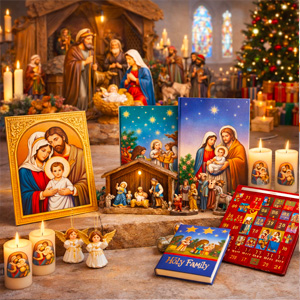
Through Anne, Joachim, Mary and Jesus, we also contemplate a family in which faith is passed down from one generation to the next.
The Nativity of the Virgin Mary in Christian art
The Nativity of the Virgin Mary has inspired many artists over the centuries.
Painters, sculptors and iconographers have depicted Saint Anne after Mary’s birth, surrounded by women who have come to care for the mother and child.
These scenes often have a very family-oriented feel.
In them, Mary does not yet appear as the majestic Queen of Heaven found in certain Marian depictions.
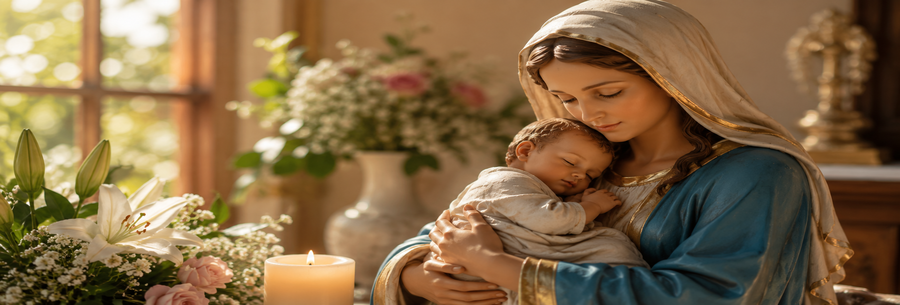
She is simply a newborn baby.
It is this simplicity that gives the scene its beauty.
The woman who would become the Mother of Christ begins her life just like the rest of us: in the fragility of a child who needs to be welcomed, nourished and loved.
How can we celebrate the Nativity of Mary?
8 September can be observed very simply.
For Catholics, attending Mass is naturally a lovely way to celebrate this feast day.
But it is also possible to set aside a few minutes during the day for personal prayer.
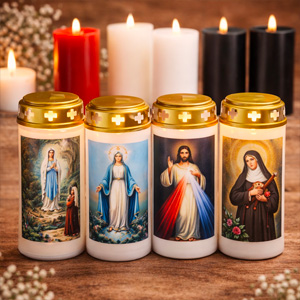
You can light a candle before a statue or image of the Virgin Mary and entrust your intentions to her.
You can also recite a decade of the Rosary or, if you have more time, pray the whole Rosary.
Finally, this day can be an opportunity for a very simple gesture: placing flowers before an image of the Virgin Mary.
The most important thing is to make this feast day a time of encounter with God through prayer.
The chaplet: a beautiful prayer for 8 September
The chaplet holds a special place in Marian devotion.
By repeating the ‘Hail Mary’, the believer meditates on the great events of Christ’s life alongside his Mother.
On 8 September, we can take up our rosary and entrust each decade to a particular intention.
A decade for our family.
A decade for the sick.
A decade for children.
A decade for those who are suffering.
A decade for peace.
There is no need for long speeches.
Prayer can be very simple.
Mary already knows what is in our hearts.
The Nativity of Mary and Our Lady of Lourdes
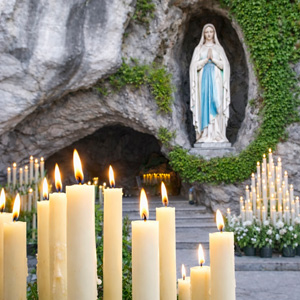
For those who are particularly devoted to Our Lady of Lourdes, 8 September can also be observed in communion with the sanctuary at Massabielle.
At Lourdes, Mary appeared to Bernadette Soubirous as ‘the Immaculate Conception’.
These words take us straight to the mystery of Mary and the special grace she received from the very beginning of her existence.
At the Grotto of Massabielle, millions of pilgrims come every year to offer their prayers.
Some ask for healing.
Others come to give thanks.
Still others are at a loss for words and simply remain in silence for a few minutes before the Grotto.
On 8 September, we can unite ourselves spiritually with all these pilgrims and entrust our loved ones to Our Lady of Lourdes.
A feast day to give thanks to Mary
We often ask a great deal of the Virgin Mary.
We entrust our worries, our sufferings and our requests to her.
But her feast day can also be a time simply to say thank you to her.
Thank you for her trust in God.
Thank you for her ‘yes’.
Thank you for welcoming Jesus.
Thank you for standing by her Son right up to the Cross.
Thank you for that maternal presence which so many generations of Christians have found in her.
8 September can thus become a day of gratitude.
Prayer for the Nativity of the Virgin Mary
O Mary, on this day when we celebrate your birth,
we come to you with confidence and joy.
You whom God chose
to become the Mother of his Son,
teach us to accept his will
with the same trust as you.
Watch over our families,
protect our children
and be with those we love.
Comfort those who are suffering,
support the sick,
comfort those who mourn
and restore hope to those who are discouraged.
Mary, Mother full of tenderness,
we entrust to you today
all the intentions we hold in our hearts.
Present them to your Son, Jesus.
Help us to grow in faith,
to forgive,
to love more
and to remain faithful in difficult times.
Our Lady of Lourdes,
watch over all those who come to you
with their wounds, their fears and their hopes.
On this joyful feast of your Nativity,
guide our steps towards Jesus
and keep our families under your motherly protection.
Blessed Virgin Mary, pray for us.
Amen.
Happy Feast of the Nativity of the Virgin Mary!
On 8 September, let us take a few moments to joyfully celebrate the birth of Mary.
This little girl, born over two thousand years ago, was to become the Mother of Jesus and occupy a unique place in Christian history.
Her life reminds us that a life offered to God can bear fruit that we cannot always imagine.
When we are anxious about the future, let us look to Mary.
When we are going through a trial, let us entrust ourselves to her intercession.
When we have lost hope, let us ask her to lead us to her Son.
And when our lives are filled with joy, let us not forget to come and thank her either.
On this 8 September, let us entrust to the Virgin Mary our families, our loved ones and all those who need our prayers.
A very happy Feast of the Nativity of the Blessed Virgin Mary to you all. May Mary watch over you and always lead you to her Son, Jesus.